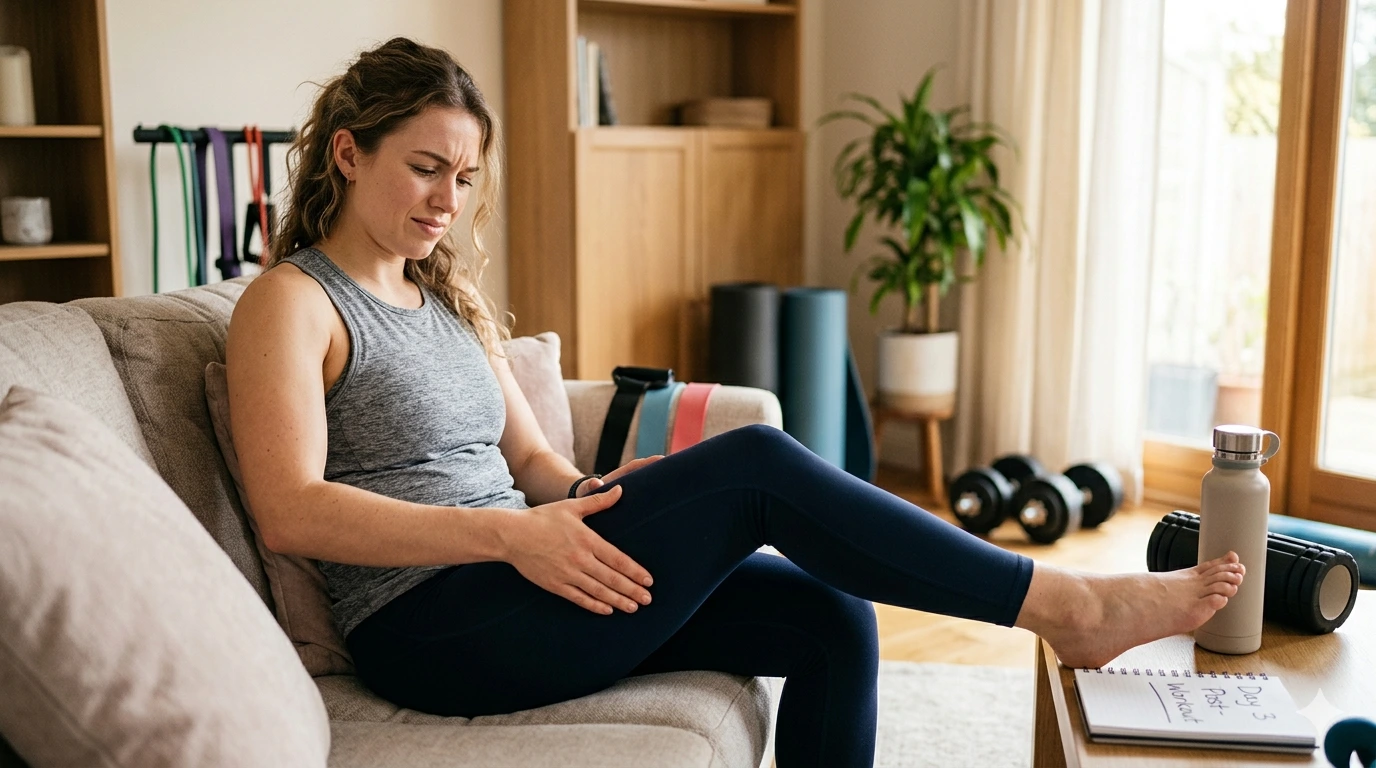
You crushed a workout on Monday, and by Wednesday afternoon, every squat feels like a betrayal. That deep, dull ache — especially when you go from sitting to standing — can make you wonder if something went wrong. The short answer: yes, it’s completely normal to feel sore three days after a workout. But there’s a difference between typical muscle repair and a sign of overtraining or injury.
This type of late-appearing soreness has a name: Delayed Onset Muscle Soreness (DOMS). It’s not only common — it’s actually a predictable part of getting stronger. That said, knowing what’s normal and what’s not can save you from unnecessary worry (or a real injury).
💡 This guide explains why soreness peaks on day three, how to tell if you’ve overdone it, and evidence-based ways to recover faster — without losing your training momentum.
📋 Table of Contents
- 🔍 What Is Delayed Onset Muscle Soreness (DOMS)?
- ⏱️ Why Does Soreness Peak 3 Days After a Workout?
- 🟢 Normal vs. Warning Signs: Is It Just Soreness or Injury?
- 🧊 How to Recover Faster From Late Muscle Soreness
- 🚨 When Should You Worry? Red Flags to Watch For
- 🛡️ Preventing Extreme Soreness Next Time (Without Skipping Gains)
- ❓ Frequently Asked Questions
🔍 What Is Delayed Onset Muscle Soreness (DOMS)?
If you’ve ever woken up two days after a tough workout feeling stiffer than the day before, you’ve met Delayed Onset Muscle Soreness (DOMS). Unlike the sharp, immediate pain of a pulled muscle, DOMS is a dull, diffuse ache that typically starts 12–24 hours after exercise and peaks around 48–72 hours. So yes, feeling sore 3 days after a workout is not only normal — it’s textbook DOMS.
What’s actually happening inside your muscles? Microscopic tears occur in the muscle fibers, especially after eccentric movements (like lowering a weight or running downhill). Your body responds with an inflammatory repair process that recruits immune cells and fluid, leading to that familiar achiness. According to the American College of Sports Medicine (2021), DOMS is a normal adaptation response — it means your nervous system and muscles are remodeling to handle future loads.
That said, not every ache is DOMS. Joint pain, sharp twinges, or swelling point to something else. But if you’re just dealing with tenderness and reduced range of motion, you’re in the clear. Feeling sore three days after a workout is actually a sign you challenged your body in a new way — and that’s how progress happens.
⏱️ Why Does Soreness Peak 3 Days After a Workout?
You’d think the worst soreness would hit the morning after. But for many people, day three is the actual peak. That seems backward — until you understand the timeline of muscle repair. Right after exercise, your muscles are fatigued but not yet inflamed. The inflammatory cascade ramps up slowly, and the release of bradykinin and prostaglandins (chemicals that sensitize nerve endings) takes time. By 48 to 72 hours, the combination of swelling, cellular debris cleanup, and nerve sensitivity hits its maximum. That’s why feeling sore 3 days after a workout is so common — it’s the natural crescendo of your body’s repair symphony.
Research from the Journal of Applied Physiology (2019) shows that eccentric exercise — think lowering a dumbbell slowly or landing from a jump — produces the longest-lasting DOMS. Your muscles are literally being stretched under tension, causing more microtears than concentric (shortening) moves. So if your workout included new exercises, higher volume, or slower negatives, day-three soreness is almost guaranteed.
Interestingly, not everyone experiences the same peak. Age, fitness level, and even genetics play a role. But one thing is consistent: if you’ve taken a break from training for two weeks or more, your muscles become “naive” again, and DOMS will return more intensely. The good news? That delayed soreness is temporary and typically fades by day five. Feeling sore three days after a workout is your body’s way of saying, “I’m adapting — but I need a little patience.”
“Is the soreness symmetrical (both legs, both arms)?” + “Does it feel better with light movement?”
If you answered yes to both, you’re likely dealing with normal DOMS — not an injury. That’s a green light for active recovery.
🟢 Normal vs. Warning Signs: Is It Just Soreness or Injury?
It’s easy to spiral into worry when you’re still hobbling on day three. Let’s draw a clear line. Normal DOMS feels like a deep, heavy ache that’s worse with initial movement but loosens up after a few minutes. You might notice stiffness when climbing stairs or reaching overhead, and the soreness is typically diffuse (spread over a muscle group), not pinpoint. Feeling sore 3 days after a workout under those conditions is absolutely expected — especially after a leg day or a new routine.
Warning signs, on the other hand, include sharp, stabbing pain with movement, pain that worsens instead of improves over 72 hours, or visible swelling and bruising. If you feel a sudden “pop” during exercise, that’s an immediate red flag. Another clue: joint pain (knee, elbow, shoulder) is not DOMS — DOMS lives in the muscle belly, not the joint line. According to a 2022 review in Sports Health, differentiating DOMS from muscle strain comes down to timing and quality of pain. Strains hurt immediately or within a few hours, and the pain is often reproducible by pressing a specific spot.
Still unsure? Try the gentle stretch test. With DOMS, a light stretch feels uncomfortable but not agonizing. With a strain, even a tiny stretch can cause a knife-like sensation. And if your urine turns dark brown or pink — that’s not DOMS; that’s a medical emergency (rhabdomyolysis) and you need to go to an ER immediately. But for the vast majority of people, feeling sore three days after a workout is just your muscles remodeling themselves. That’s a win.
“Does pressing a single spot cause a jolt of pain?” + “Is the pain worse at night when resting?”
If yes to either, skip the home treatment and consider seeing a physiotherapist — it might be more than DOMS.
🧊 How to Recover Faster From Late Muscle Soreness
You don’t have to just suffer through day three. Evidence-based recovery can cut down the duration and intensity. First, light movement is surprisingly effective — think a 15-minute walk, easy cycling, or dynamic stretching. Why? Movement increases blood flow without adding more muscle damage, helping clear inflammatory debris. Feeling sore 3 days after a workout? A short recovery ride might be the best thing you can do.
Contrast water therapy (alternating hot and cold) has shown modest benefits in a 2020 meta-analysis from Sports Medicine. Try one minute cold, two minutes hot, repeat three times. Ice baths alone? They may blunt the hypertrophy signal, so use them only if pain is severe. Nutrition matters too: protein intake within two hours post-workout (around 0.4 g/kg body weight) supports repair. Tart cherry juice and omega-3s have some data behind them, but they’re not magic.
What doesn’t work? Static stretching before muscles are warm may actually increase soreness. And anti-inflammatory medications like ibuprofen — while they reduce pain — might interfere with long-term adaptation if used every time. Save them for when you can’t function. The key takeaway: gentle activity, hydration, and sleep are your real recovery tools. Feeling sore three days after a workout isn’t a punishment; it’s a signal to prioritize recovery, not more intensity.
“Have you eaten protein within 2 hours of your last workout?” + “Did you get 7+ hours of sleep last night?”
If you missed both, that’s likely why soreness feels worse than expected — these are two of the biggest levers you can pull for next time.
🚨 When Should You Worry? Red Flags to Watch For
Feeling sore 3 days after a workout is rarely dangerous, but there are absolute deal-breakers. Dark urine (tea or cola-colored) is the biggest warning sign — it could indicate rhabdomyolysis, a breakdown of muscle tissue that can damage kidneys. This is rare but real, especially after extreme workouts, high heat, or when dehydrated. Other red flags: inability to move a joint through its full range, progressive swelling, or numbness/tingling in an extremity.
If your soreness continues to worsen after day three instead of improving, that’s unusual. Normal DOMS peaks at 48–72 hours and then slowly declines. By day five, most people feel dramatically better. Fever, chills, or redness over the muscle suggest infection or compartment syndrome — both require immediate medical attention. And if you feel a “crack” or “pop” at the time of injury followed by bruising, that’s likely a muscle strain or tear, not DOMS.
In my opinion, it’s always better to err on the side of caution. If you’re unsure after reading this, most physical therapists offer a quick telehealth consult. But for the typical healthy person who introduced a new exercise or came back from a break, feeling sore three days after a workout is simply part of the process. Listen to your body, but don’t panic over predictable muscle ache.
“Is your urine normal color?” + “Can you walk or raise your arms without sharp pain?”
If you answered yes to both, you’re safe to recover at home — no doctor needed unless symptoms change.
🛡️ Preventing Extreme Soreness Next Time (Without Skipping Gains)
You don’t have to eliminate DOMS entirely — in fact, you can’t if you want to progress. But you can reduce how brutal day three feels. Gradual progression is the single most effective strategy. Increase weight, reps, or volume by no more than 10% per week. Jumping from zero to a 60-minute HIIT class is a recipe for severe soreness. Feeling sore 3 days after a workout is milder and shorter when you build up slowly.
Warm-up properly — a light cardio warm-up plus dynamic movements (leg swings, arm circles) prepares muscles for eccentric loading. Cool-down with low-intensity activity, not static stretching. Another underrated trick: stay hydrated before, during, and after exercise. Dehydration exacerbates muscle damage markers, according to a 2018 study in the European Journal of Applied Physiology.
If you’re returning after a long layoff, consider a “re-intro” week: half the sets or half the weight of what you used to do. Your muscles will still get the novelty stimulus, but the soreness will be manageable rather than debilitating. Remember, feeling sore three days after a workout isn’t a badge of honor or a sign of failure — it’s a data point. Use it to gauge how aggressively you should progress next time.
“Did you increase your workout load by more than 20% this week?” + “Did you skip a warm-up?”
If yes to either, try a smaller jump next time and add 5 minutes of dynamic warm-up — it’s the lowest-hanging fruit for prevention.
❓ Frequently Asked Questions
Q1. Is it normal to feel sore 3 days after a workout if I’m a beginner?
A1. Absolutely. Beginners experience more intense DOMS because their muscles aren’t accustomed to eccentric loading. Feeling sore 3 days after a workout is actually more common in new exercisers than in seasoned athletes. The soreness will lessen as you build consistency over 4–6 weeks.
Q2. Should I work out again while still sore from 3 days ago?
A2. It depends. Light cardio or mobility work is fine and may speed recovery. But heavy strength training on the same muscle groups while severely sore? Wait until the soreness drops to a 2–3 out of 10. Training through extreme DOMS raises injury risk and doesn’t build more muscle.
Q3. Can I take pain relievers for DOMS?
A3. Occasional use of NSAIDs (like ibuprofen) for unbearable discomfort is okay, but regular use may blunt muscle adaptations. Paracetamol/acetaminophen can help without interfering as much, but always follow local guidelines and consult a pharmacist if you have medical conditions.
Q4. Does being sore mean I had a good workout?
A4. Not necessarily. Soreness is a sign of novelty or high eccentric load — not a measure of workout quality. You can have a highly effective workout with little to no soreness once you’re adapted. Conversely, a poorly structured workout can still leave you sore. Focus on performance and progress, not pain.
Q5. How many days of muscle soreness is too many?
A5. DOMS lasting 5–7 days is still within normal range for extremely intense or unfamiliar exercise. If soreness persists beyond 7 days without improvement, or if it gets worse after day 3, consider seeing a healthcare provider. Feeling sore 3 days after a workout is peak — it should start fading by day 4.
Q6. Does stretching help DOMS once it’s already here?
A6. Light, dynamic stretching after warming up may provide temporary relief. But aggressive static stretching of already sore muscles doesn’t reduce DOMS duration and could increase discomfort. Gentle movement like walking or yoga is more helpful.
Q7. Why am I sore 3 days later but not the next day?
A7. That’s the classic DOMS timeline. Inflammatory mediators and fluid accumulation take time to build. Many people feel fine at 24 hours, then wake up on day two or three with significant stiffness. It’s completely normal and doesn’t mean you’re injured.
Q8. Can poor nutrition make DOMS worse?
A8. Yes. Inadequate protein intake, low carbohydrate stores, and dehydration can prolong recovery and increase perceived soreness. A balanced meal within two hours after exercise, plus consistent hydration, makes a measurable difference. Feeling sore 3 days after a workout is less intense when your body has the building blocks it needs.
Disclaimer: The information in this post is for general informational purposes only and reflects guidelines available as of 2025. DOMS experiences vary by individual. Always consult a qualified healthcare professional before starting a new exercise program or if you have persistent pain. This post does not constitute medical advice.