Eight hours in a chair. Hunched shoulders. A stiff neck that cracks when you finally stand up. If that sounds familiar, you’re not alone. Millions of desk workers deal with the same daily aches — and the long-term health risks are real.
The good news? You don’t need a gym membership or an hour of free time. A few targeted movement breaks and simple exercises can undo most of the damage caused by sitting all day.
💡 This guide walks you through a complete desk-friendly workout routine — from 30-second stretches to 10-minute strength circuits. No special equipment needed.
📋 Table of Contents
🧠 Why Sitting All Day Hurts (Even If You Exercise)
You might hit the gym three times a week and still wake up with a sore lower back. That’s because prolonged sitting changes how your muscles and spine behave — in ways that a single workout can’t fully reverse.
When you sit for hours, your hip flexors shorten and tighten, your glutes switch off, and your upper trapezius muscles constantly strain to hold your head up. According to the World Health Organization (2022), sedentary behavior is a leading risk factor for musculoskeletal disorders and metabolic disease — independent of how much you exercise otherwise.
The key difference is frequency over intensity. A 60-minute workout doesn’t cancel out 9 hours of stillness. What actually helps is sprinkling small movement “snacks” throughout your day.
That said, you don’t need to overhaul your life. Small, consistent adjustments — like the ones in this guide — add up faster than you’d think.
“Do you feel tightness in your hips or lower back after work?” + “Do you often catch yourself slouching?”
If yes, your body is asking for more frequent movement breaks — and the next sections show you exactly what to do.
🪑 5 Desk Stretches You Can Do Right Now
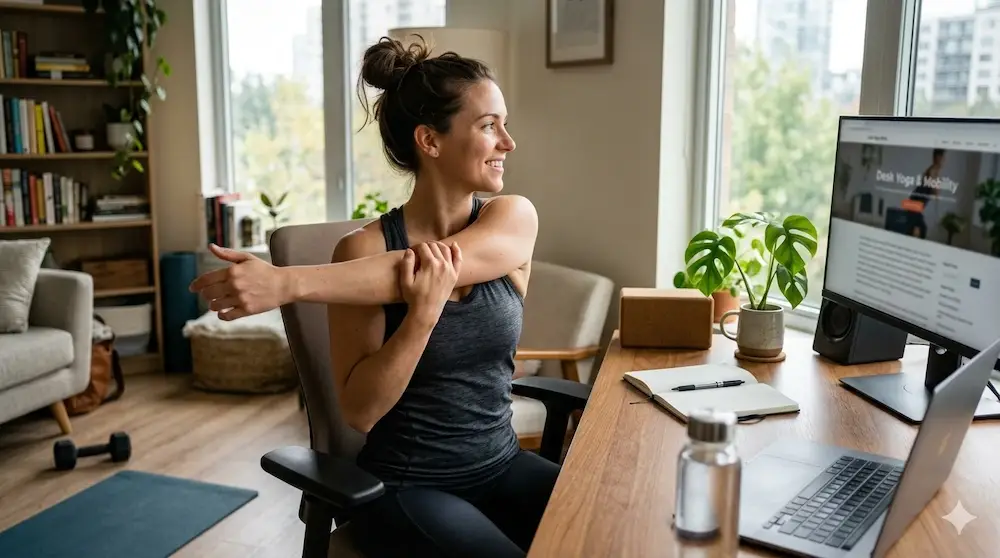
These stretches require zero equipment and take less than two minutes. Do them every hour — set a timer if you have to. The goal is to interrupt prolonged sitting, not to become flexible overnight.
1. Seated Neck Release
Sit tall, gently drop your right ear toward your right shoulder. Hold for 15 seconds, then switch. You’ll feel a pull along the opposite side of your neck. This helps counter “text neck” and upper trap tightness.
2. Open Book Twist
While seated, place your left hand on the back of your chair and your right hand on your left knee. Twist your torso to the left, looking over your shoulder. Hold for 10 seconds, repeat on the other side. This mobilizes your thoracic spine — an area that gets notoriously stiff from slouching.
3. Wrist and Finger Stretch
Extend one arm forward, palm up. Use your other hand to gently pull your fingers down and back. Then do palm down. Typing all day shortens wrist flexors; this stretch prevents carpal tunnel-like symptoms.
4. Seated Pigeon (Pretzel Stretch)
Cross one ankle over the opposite knee, keeping the bent knee relaxed. Lean forward slightly from your hips. You’ll feel this deep in your glutes. Sitting makes your glutes go dormant — waking them up improves hip mobility.
5. Standing Back Extension
Stand up, place your hands on your lower back, and gently lean backward, looking at the ceiling. This reverses the forward-hunched posture you’ve been in all morning.
If you’re unsure whether you’re doing these correctly, watch a quick video demo from a trusted source like the NHS or Mayo Clinic. But honestly, even an imperfect stretch beats no stretch at all.
“Have you stood up in the last 60 minutes?”
If not, stand up now and do just one of the stretches above. That single action breaks the sedentary cycle.
⏰ The 7-Minute Midday Movement Routine
This routine is designed for your lunch break or a quick afternoon reset. It combines cardio, mobility, and light strength to reverse the physiological effects of sitting. No running or jumping required — office-friendly.
Minute 1: March in place, lifting your knees high. Swing your arms. This increases blood flow and wakes up your nervous system.
Minute 2: Hip circles (10 each direction) plus torso twists with arms extended. Focus on moving your spine in all directions.
Minute 3: Wall push-ups. Stand facing a wall, place your hands on it, and lower your chest toward the wall. This activates your chest and shoulders without putting pressure on your wrists.
Minute 4: Bodyweight squats (as many as you can with good form). Keep your heels down and chest up. Sitting all day weakens your glutes; squats directly oppose that.
Minute 5: Standing rear leg lifts (10 each side). Hold the back of your chair for balance. This targets the gluteus medius, a muscle that becomes inactive during prolonged sitting.
Minute 6: Calf raises (15–20 reps). Lift your heels off the ground while standing. Sitting slows circulation in your lower legs; calf raises act as a venous pump.
Minute 7: Deep breathing with a forward fold. Stand, exhale as you hinge at your hips and let your head hang heavy. Breathe deeply for 30 seconds. This calms your stress response and stretches your entire back chain.
From what I’ve seen, people who do this routine just three times a week report less afternoon fatigue and fewer back twinges. It’s not a workout — it’s a reset.
Set a repeating alarm for 12:30 PM labeled “7-Minute Movement.”
When it goes off, do the routine above. After one week, notice how your 3 PM slump changes.
💪 Strengthening Exercises for Desk Workers
Stretching feels good, but strength training fixes the root cause of sitting pain: muscle imbalances. Here are three key exercises that directly target the damage done by chairs.
1. Glute Bridges (Combat “Dead Butt Syndrome”)
Lie on your back with knees bent, feet flat. Squeeze your glutes to lift your hips toward the ceiling. Lower slowly. Do 15 reps. Research from the American Council on Exercise (2021) shows glute bridges are one of the most effective moves for reactivating dormant glutes.
2. Prone Y Raises (Fix Rounded Shoulders)
Lie face down on the floor with arms extended overhead in a Y shape. Lift your arms and thumbs up toward the ceiling, squeezing between your shoulder blades. This strengthens the lower traps and rhomboids — muscles that get stretched and weakened by slouching.
3. Plank with Shoulder Taps
Hold a high plank position. Tap your right hand to your left shoulder, then left to right. Keep your hips steady. This builds core stability and teaches your body to resist rotation — something sitting never challenges.
You can do these at home in under 10 minutes. Twice a week is enough to see noticeable change in four to six weeks.
“Can you do 10 glute bridges without your lower back taking over?”
If not, slow down and focus on squeezing your glutes at the top. Quality over quantity.
📐 How to Fix Your Posture (Without Thinking About It)
Telling yourself to “sit up straight” all day is exhausting and rarely works. Instead, change your environment so good posture becomes automatic.
Adjust your screen height so the top third of your monitor is at eye level. When you look straight ahead, your gaze should hit that line. Laptops are posture killers — use a separate keyboard and elevate the screen.
Use a lumbar support (a rolled towel works). Place it at the small of your back. This naturally tilts your pelvis forward, which reduces slouching.
Try a sit-stand desk transition. Research from the CDC (2023) suggests that alternating between sitting and standing every 30–45 minutes reduces back pain by 54% compared to sitting all day. You don’t need a fancy desk — a sturdy box or stack of books can create a standing workstation.
Phone position matters. When using your phone, bring it up to eye level rather than dropping your head. Every inch your head moves forward adds about 10 pounds of force on your neck.
Honestly, the best posture is your next posture. Change positions frequently, even if each position isn’t perfect.
Right now, look at your screen. Is your chin tucked or jutting forward?
Perform a chin tuck: pull your head straight back like making a double chin. Hold 5 seconds. Repeat 5 times. Do this every time you check your phone.
📅 Building a Sustainable Desk-Workout Habit
The best workout routine is the one you actually stick with. Here’s how to make these movements automatic without willpower battles.
Anchor new habits to existing ones. Every time you finish a call, do 10 seated leg lifts. After you use the restroom, do a 30-second neck stretch. This is called “habit stacking” — it works because your brain already has the first trigger wired.
Start laughably small. Commit to one minute of movement per hour. That’s it. Once that feels easy, expand to two minutes. According to behavioral science research from University College London (2020), tiny habits are 3x more likely to stick than ambitious ones.
Track your “active hours.” Use a fitness tracker or a simple paper log. The goal isn’t steps — it’s frequency of breaks. Aim for at least one standing-and-stretching break every 60 minutes.
Make it social. Ask a coworker to join you for the 7-minute midday routine. Accountability doubles follow-through, plus it’s more fun.
In my opinion, the single most effective change is to treat movement breaks as non-negotiable meetings with yourself. Block them on your calendar. Your future spine will thank you.
Choose just one exercise from this guide.
Do it tomorrow morning. Then add another the next week. Momentum beats perfection.
❓ Frequently Asked Questions
Q1. How often should I do these desk workouts to see results?
A1. For pain relief, aim for hourly micro-breaks (1–2 minutes) plus the 7-minute midday routine 3–4 times per week. For strength changes, add the strengthening exercises twice weekly. Most people feel less stiff within 5–7 days.
Q2. Can I do these exercises if I have chronic back pain?
A2. It depends on the cause. If you have diagnosed conditions like herniated discs or sciatica, check with a physical therapist first. For general “sitting soreness,” start with the gentler stretches and stop if anything sharpens pain.
Q3. What’s better: a standing desk or these exercises?
A3. Both. Standing desks reduce some spinal load but don’t strengthen weak muscles. The ideal combination is a sit-stand desk plus the movement breaks described here. Neither alone solves the whole problem.
Q4. How do I stay consistent when work gets busy?
A4. Use the “one-minute rule.” When you’re swamped, do just 60 seconds of the seated stretches. That’s enough to interrupt the sedentary cascade. Later, when things calm down, you can add more.
Q5. Will these exercises help with wrist pain from typing?
A5. Yes, particularly the wrist stretches and the strengthening exercises that improve shoulder posture. Often, wrist pain originates from tight neck and shoulder muscles — fixing those reduces strain on your wrists.
Q6. Are there any risks to doing these movements?
A6. These are low-risk exercises suitable for most healthy adults. Avoid any movement that causes joint pain (not muscle stretch). If you have osteoporosis or recent surgery, get medical clearance first.
Q7. Can I do these without leaving my desk?
A7. Most of the seated stretches and the 7-minute routine can be done right beside your desk. Only the strengthening exercises (glute bridges, planks) require floor space — those are best done at home or in a break room.
Q8. How long until I fix my “text neck” or rounded shoulders?
A8. With daily consistency, most people see visible improvement in posture within 4–6 weeks. The underlying muscle strength takes about 8–12 weeks to rebalance completely. Stick with it — these changes last a lifetime.
Disclaimer: This information is for general educational purposes only and does not replace professional medical advice. Always consult a qualified healthcare provider before starting a new exercise routine, especially if you have pre-existing injuries or medical conditions. Individual results vary.
Tags: Desk Workout, Office Exercise, Posture Fix, Sitting Pain Relief, Work Stretches, Sedentary Lifestyle, Back Pain Prevention, Workplace Wellness