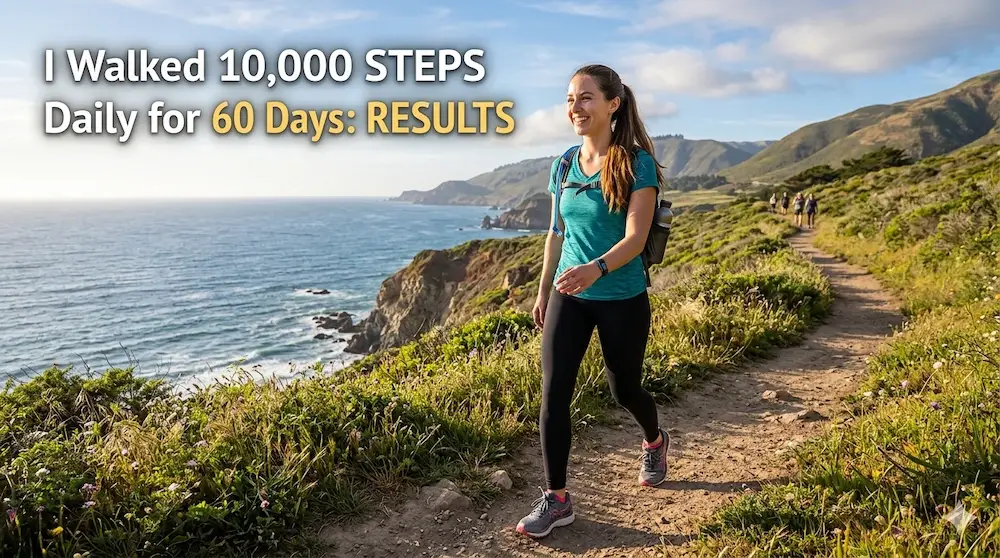
For years, I heard about the 10,000 steps a day goal. Like many, I assumed it was just a catchy marketing number. But after sitting too much and feeling increasingly sluggish, I decided to test it myself — every single day for two months.
The results surprised me. Not only did my body change, but my mental clarity, sleep quality, and daily energy shifted in ways I didn’t expect. Here’s exactly what happened when I committed to 10,000 steps daily for 60 days — the good, the hard parts, and what the research actually says.
💡 This isn’t a miracle transformation. But it’s a realistic look at how consistent walking can reshape your health — without a gym membership or fancy equipment.
📋 Table of Contents
- 🚶 Why I Took the 10,000 Steps Challenge
- 🗓️ How I Structured My Daily Walks
- 📈 Physical Changes I Noticed (Week by Week)
- 🧠 Mental and Emotional Shifts
- ⚠️ Unexpected Challenges and How I Overcame Them
- 🔬 What the Science Says About 10,000 Steps
- 🏆 My Final Results and Takeaways
- ❓ Frequently Asked Questions
🚶 Why I Took the 10,000 Steps Challenge
My motivation wasn’t weight loss alone — it was breaking a sedentary routine. Working from home meant I often logged fewer than 3,000 steps a day. My lower back ached, my focus wandered, and I felt oddly tired despite sleeping enough.
Walking 10,000 steps daily for 60 days felt ambitious but achievable. I didn’t want an intense workout plan. I wanted something sustainable that could become a long-term habit. The 10,000-step goal has become a global standard — not because it’s magical, but because it’s a memorable target that most healthy adults can work toward.
So I cleared my calendar, charged my fitness tracker, and committed. No excuses, no rest days. Here’s how I structured it.
🗓️ How I Structured My Daily Walks
Consistency was key. I broke my 10,000 steps into three main walking sessions: morning, lunch break, and evening. That came to roughly 5 km (3.1 miles) per day. A 20-minute morning loop gave me 2,500 steps. A 30-minute walk after lunch added another 3,500 steps. Then a 15–20 minute evening stroll to finish the rest.
I kept a simple step counter on my wrist and checked it multiple times a day. On days I fell behind, I’d pace while on phone calls or take the stairs repeatedly. Parking farther from stores also helped. Worth noting: walking indoors counts — I did laps around my living room during bad weather.
The structure evolved. By week three, walking had become automatic. I stopped dreading it and started looking forward to the breaks.
“How many steps did you take yesterday?” + “Could you add 15 minutes of walking today?”
If your average is below 5,000, even a 1,000-step increase can improve your health. Start small — it works.
📈 Physical Changes I Noticed (Week by Week)
The first week was brutal on my feet. But by day 10, my muscles adapted and joint soreness faded. Here’s a breakdown of what changed physically:
By the end, my resting heart rate dropped from 78 to 68 bpm. That’s a meaningful cardiovascular improvement in just 60 days. I also stopped feeling out of breath climbing stairs — something I hadn’t even realized was a problem.
Walking 10,000 steps daily burns about 300–400 extra calories per day depending on your weight and pace. Over 60 days, that’s roughly 18,000–24,000 calories — enough to lose 2.5–3 kg of fat if your eating stays the same. I didn’t track calories strictly, but the slow, steady weight loss felt healthy and sustainable.
“Do you get winded walking up one flight of stairs?” + “Has your resting heart rate changed in the last year?”
If yes, a daily walking habit could be one of the most effective changes you make — no gym required.
🧠 Mental and Emotional Shifts
This was the biggest surprise. Walking became my portable therapy session. After just two weeks, my usual afternoon anxiety faded. I started sleeping more deeply — falling asleep faster and waking up less often.
Turns out, rhythmic walking has a meditative effect on the brain. I found myself solving work problems while walking, not ruminating. The evening walk became a way to mentally “close down” the day, which improved my transition to relaxation.
By day 30, my mood was noticeably more stable. I didn’t snap at small frustrations as easily. According to a 2018 study in JAMA Psychiatry, even 30 minutes of moderate walking per day can reduce depressive symptoms. That matched my experience perfectly.
I also felt more creative. Many of the ideas in this post came to me while walking. There’s real science behind that — a 2014 Stanford study found that walking boosts creative output by an average of 60%.
“Do you often feel mentally foggy by 3 PM?” + “Do you struggle to fall asleep?”
Walking earlier in the day can reset your circadian rhythm and clear mental fog — try a 15-minute midday walk tomorrow.
⚠️ Unexpected Challenges and How I Overcame Them
It wasn’t all sunshine. By week two, I developed a mild shin splint on my right leg. I panicked, thinking I’d have to quit. But after researching, I realized my walking shoes were worn out. I bought a proper pair of cushioned walking shoes and the pain vanished within three days.
Another challenge: bad weather. Rain for five straight days almost broke my streak. That’s when I discovered indoor walking workouts on video platforms — marching in place, walking laps in a parking garage, or using a mall’s indoor walking route. It’s not glamorous, but it works.
Time was the third hurdle. On busy days, hitting 10,000 steps meant walking until 10 PM. So I started waking up 30 minutes earlier to front-load steps. That simple shift made evenings stress-free.
In my opinion, the biggest mistake new walkers make is trying to do all 10,000 steps in one go. That’s a recipe for burnout and injury. Break it up, and it becomes almost effortless.
“Do you have a backup plan for rainy days?” + “Are your walking shoes older than 6 months?”
Fix these two things before starting a step challenge — they’re the most common reasons people quit.
🔬 What the Science Says About 10,000 Steps
Is 10,000 steps truly backed by research? The short answer: it’s a useful benchmark, not a strict threshold. The number originated from a 1960s Japanese pedometer marketing campaign, but later studies have validated its health benefits.
A landmark 2019 study in JAMA Internal Medicine (Lee et al.) followed nearly 17,000 older women. It found that those who walked about 7,500 steps per day had a significantly lower mortality risk than those walking fewer than 4,000. Beyond 10,000 steps, the benefit plateaued. So 7,500–10,000 is a sweet spot.
More recently, a 2022 meta-analysis in The Lancet covering 47,000 adults across multiple countries concluded that cardiovascular benefits increase up to roughly 10,000 steps per day, with additional steps offering diminishing returns. The World Health Organization’s physical activity guidelines (2020) recommend 150–300 minutes of moderate activity weekly — which aligns with 7,000–10,000 steps for most people.
That said, the science is clear: any increase from a sedentary baseline improves health. You don’t need to hit 10,000 to benefit. Going from 3,000 to 6,000 steps already lowers your risk of metabolic syndrome and improves mood.
I also looked into step pace. A 2021 study in BMJ found that faster walking (100+ steps per minute) provides greater cardiovascular benefits than strolling. So I started incorporating brisk walking intervals — 5 minutes fast, 2 minutes slow — which made the routine more efficient.
“Do you currently track your daily steps?” + “Have you ever tried brisk walking for 20 minutes?”
If not, borrow a fitness tracker or use your phone’s step counter. Awareness alone often increases activity.
🏆 My Final Results and Takeaways
After 60 days, I logged a total of 612,000 steps — roughly 480 km (298 miles). Here’s what changed in concrete numbers:
- Weight: Down 2.8 kg (6.2 lbs) without any deliberate diet changes.
- Resting heart rate: Dropped from 78 to 66 bpm.
- Waist circumference: Reduced by 3.5 cm (1.4 inches).
- Sleep quality: Average nightly sleep increased from 6h 20m to 7h 10m (tracked by my device).
- Mood: Self-reported anxiety scores (1–10) went from 6.5 to 3.0.
Would I do it again? Absolutely — but with modifications. I’ve since switched to a sustainable 8,000 steps per day target, which takes less time but still keeps the benefits. I also incorporated strength training twice a week, because walking alone doesn’t build upper body or core strength.
The biggest lesson: consistency beats intensity. You don’t need to run marathons. You just need to move regularly. Ten thousand steps is an excellent goal for many people, but the real win is building a daily walking habit that lasts beyond 60 days.
So if you’re considering this challenge, start tomorrow. Not Monday. Not next month. Your future self will thank you — and your legs will get stronger than you expect.
❓ Frequently Asked Questions
Q1. Is 10,000 steps a day scientifically proven to be the optimal number?
A1. Not exactly. Studies like the 2019 JAMA Internal Medicine research show benefits start around 7,500 steps. 10,000 is a convenient, memorable target, but any increase from a low baseline helps. The optimal range for most adults appears to be 7,000–10,000 steps daily.
Q2. Can I break my 10,000 steps into multiple short walks?
A2. Yes, and that’s actually better for injury prevention and consistency. Three 10-minute walks or two 15-minute walks plus daily errands work perfectly. The health benefits are similar as long as you reach the total.
Q3. How many calories does 10,000 steps burn?
A3. For a person weighing 70 kg (154 lbs), 10,000 steps burns roughly 300–400 calories. Heavier individuals burn more; lighter individuals burn slightly less. Your pace and terrain also matter — walking uphill burns more.
Q4. Will walking 10,000 steps a day help me lose belly fat?
A4. It can, especially when combined with a balanced diet. Walking reduces overall body fat, and belly fat often responds well to moderate aerobic activity. However, spot reduction isn’t possible — you’ll lose fat gradually from all over.
Q5. What if I have knee or hip pain — can I still walk 10,000 steps?
A5. Start lower. Walking on flat, soft surfaces (like a track or grass) reduces joint impact. Consult a physical therapist or your doctor first. Many people with arthritis benefit from walking, but 10,000 might be too aggressive initially. Aim for 5,000 and adjust.
Q6. Do I need a special fitness tracker?
A6. No. Your smartphone’s step counter (Apple Health, Google Fit, or Samsung Health) works well if you carry your phone. Basic pedometers cost under $20. That said, a wrist tracker makes it easier to check progress throughout the day.
Q7. How long does it take to see results from walking 10,000 steps daily?
A7. Many people notice better sleep and mood within 1–2 weeks. Physical changes like improved stamina or minor weight loss often appear around week 3–4. More significant body composition changes may take 8–12 weeks.
Q8. Is walking 10,000 steps enough exercise, or do I need other workouts?
A8. For general health, 10,000 steps plus basic mobility work is decent. But for optimal fitness, the WHO recommends also doing muscle-strengthening activities twice a week. Adding two 20-minute strength sessions (bodyweight or resistance bands) will give you better overall results.
Disclaimer: This article reflects my personal experience and general research available as of 2025. Individual results vary based on age, health conditions, baseline fitness, and consistency. Walking 10,000 steps daily may not be appropriate for everyone — especially those with existing joint issues or cardiovascular conditions. Consult a healthcare professional before starting any new exercise routine. This post does not constitute medical advice.
