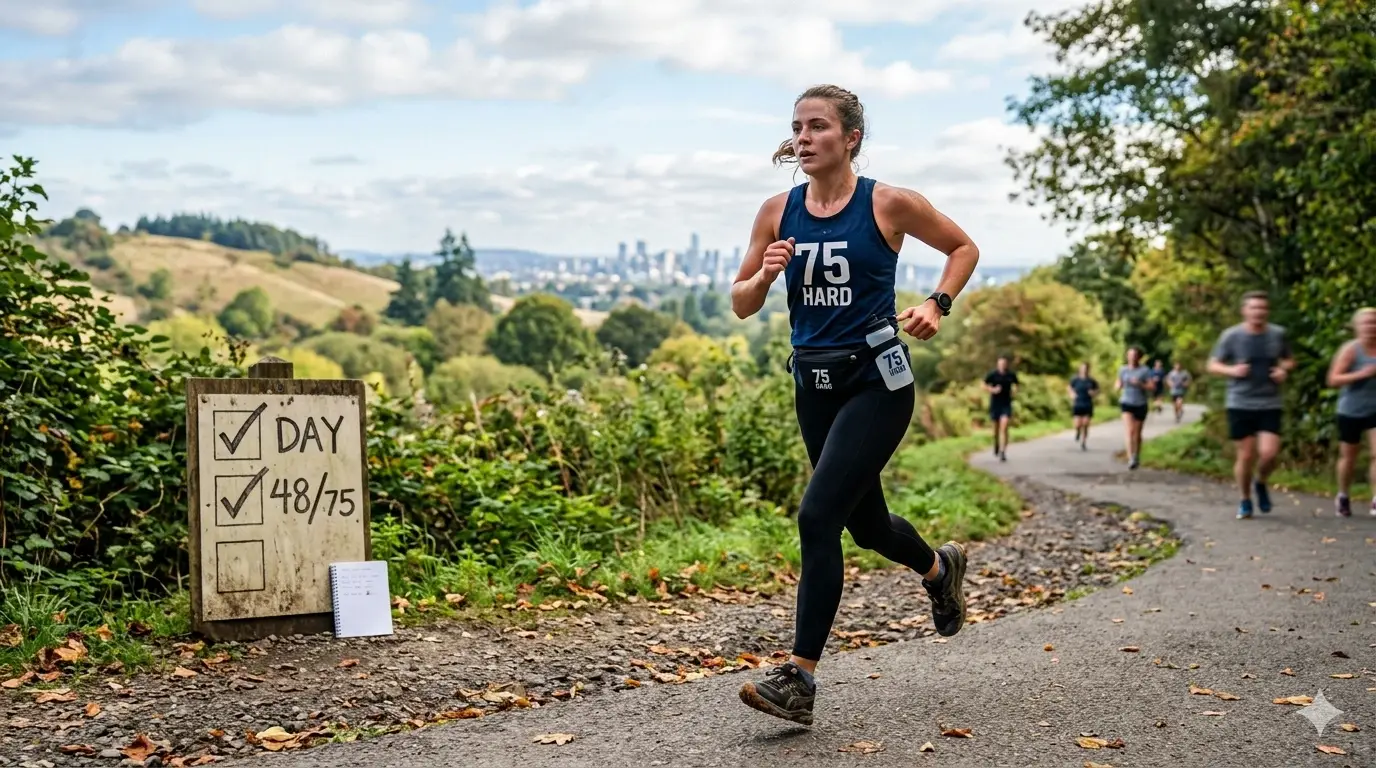
You’ve seen the before-and-after photos on Instagram. The jaw-dropping transformations, the grit-filled daily check-ins, the hashtag #75Hard. It promises to rewire your brain, crush your limits, and build unshakable discipline. But here’s the real question: does it actually work without breaking you?
The 75 Hard Challenge — created by entrepreneur Andy Frisella — isn’t your typical 30-day ab challenge. It’s a mental toughness program disguised as a fitness plan. And it’s intense. Two workouts a day, strict diet, no alcohol, a gallon of water, and 10 pages of non-fiction reading. Every single day for 75 days. Miss one task? You start over from day one.
💡 This breakdown covers what really happens when you take on 75 Hard — the wins, the risks, and whether it’s actually worth your time and health.
📋 Table of Contents
🔥 What Exactly Is the 75 Hard Challenge?
Created in 2019 by Andy Frisella, the 75 Hard Challenge is marketed as a “mental toughness program” rather than a fitness plan. The idea is simple: follow five non-negotiable rules every day for 75 days. No modifications. No skipping. If you fail any task, you restart from day one.
The program has exploded on social media, with millions of posts under #75hard. People share dramatic physical transformations, but the real claim is psychological change — better discipline, higher self-esteem, and the ability to follow through on commitments.
That said, critics argue the program’s rigidity can lead to overtraining, disordered eating, or injury. So before you buy that gallon water bottle, let’s break down exactly what you’re signing up for.
From what I’ve seen, the challenge appeals most to people who’ve tried conventional fitness routines and felt bored or unmotivated. It’s not for everyone — but for some, it’s genuinely life-changing.
“Have you finished a structured fitness program before?” + “Can you handle total failure and restart?”
If you answered no to both, you might want to start with a gentler program first — 75 Hard is famously unforgiving.
📜 The 5 Core Rules: A Complete Breakdown
Here’s where most people realize what they’re getting into. The five daily rules leave no room for interpretation. You either do them all or you start over.
1. Follow a diet — any diet, but no cheats
You pick a structured nutrition plan (keto, paleo, vegan, calorie counting, etc.) and stick to it completely. No junk meals, no “just one bite.” No alcohol is a separate rule, but it’s also part of most diets anyway.
2. Two 45-minute workouts — one must be outside
Rain or shine, snow or heatwave. The outdoor workout is non-negotiable. Walking counts, but you can’t split the 45 minutes into smaller chunks. Workouts must be at least three hours apart according to the official guidelines.
3. Drink a gallon of water (about 3.8 liters)
This one sounds easy until you’re chugging water at 10 PM to hit the mark. Exact amount: one US gallon. That’s significantly more than standard health recommendations (WHO suggests roughly 2–3 liters for adults depending on activity level).
4. Read 10 pages of non-fiction
Personal development, leadership, history, science — no fiction or audiobooks. The goal is to learn something useful every day. Most people finish 2–3 books over the 75 days.
5. No alcohol
Zero exceptions. No “just a glass of wine” at a celebration. No beer after a workout. 75 consecutive days of complete sobriety.
Turns out, the structure itself is the point. You’re not allowed to negotiate with yourself. That’s why many people find it so effective — and why others crash hard.
“Do you currently have 2.5–3 hours of free time daily?” + “Can you exercise outdoors in bad weather safely?”
If time is tight or you live in extreme climate conditions, 75 Hard will feel like a second job — plan accordingly.
✅ The Benefits That Make It Worth Considering
Despite the intensity, thousands of people swear by 75 Hard. Here’s what actually improves, based on participant reports and some behavioral science.
Discipline becomes automatic — after 75 days of doing things even when you don’t want to, your brain rewires. The “I don’t feel like it” excuse loses its power. That’s the core claim of the program, and it’s backed by research on habit formation (Lally et al., 2009, European Journal of Social Psychology — habits take 18–254 days to form).
Physical changes are real. Two workouts daily, combined with a strict diet and no alcohol, almost guarantee fat loss and muscle definition. Many participants drop 10–30 pounds, though the program explicitly says weight loss is a side effect, not the goal.
Improved sleep and mental clarity often follow the no-alcohol and water intake rules. According to the NIH (2021), chronic alcohol use disrupts REM sleep significantly. Cutting it out for 75 days gives your sleep architecture time to fully recover.
Worth noting: the sense of accomplishment is massive. Finishing something that 80% of starters reportedly quit (per unofficial community polls) builds genuine confidence. That feeling transfers to work, relationships, and other goals.
You’ll also learn how you handle pressure — and that self-knowledge is valuable whether you finish or not.
“Would completing 75 Hard be one of the hardest things you’ve ever done?”
If yes, then even attempting it will teach you something. Growth happens at the edge of your comfort zone — but not beyond your physical safety limits.
⚠️ The Real Downsides Nobody Talks About
For every success story, there’s someone who got injured, burned out, or developed an unhealthy relationship with exercise. Let’s be honest about the risks.
Overtraining is a serious concern. The World Health Organization (2022) recommends adults get 150–300 minutes of moderate exercise weekly. 75 Hard demands 630 minutes (10.5 hours) per week, plus an extra outdoor session. That’s more than double the upper end of the WHO guideline. Without proper recovery, stress fractures, tendonitis, and immune suppression become likely.
The all-or-nothing restart rule can be psychologically damaging. Miss one workout because of the flu? That’s 40 days lost. Start over. For people with perfectionist tendencies or a history of eating disorders, this setup often backfires — leading to shame spirals or even more extreme behaviors.
A gallon of water daily is excessive for smaller adults or those with kidney conditions. Hyponatremia (water intoxication) is rare but real. The European Food Safety Authority sets adequate intake at 2–2.5L for women and 2.5–3L for men — not 3.8L.
Social isolation often happens. No alcohol means skipping many social events, or showing up and feeling left out. Two workouts mean saying no to after-work dinners or weekend trips. For some, that’s a welcome boundary. For others, it strains relationships.
Finally, there’s no scientific evidence that 75 days of this specific protocol produces better long-term habits than a more moderate approach. In my opinion, the rigidity works for a small subset of people — but most would benefit from a flexible, sustainable routine instead.
“Have you ever had an eating disorder, overuse injury, or kidney issue?”
If yes, talk to your doctor before starting 75 Hard — the water and workout requirements may be unsafe for you.
🧘 Who Should (and Shouldn’t) Try 75 Hard
This isn’t a moral judgment. Some people thrive on structure; others break under it. Here’s who typically succeeds — and who should look elsewhere.
Ideal candidates have already built basic fitness and nutrition habits. If you can comfortably run 5K or lift weights 3–4 times per week, your body can handle the volume. You also need a schedule that allows 2–3 hours of free time daily — early mornings and late evenings become your new normal.
People who respond well to black-and-white rules (no negotiation, no “moderation”) often love 75 Hard. If you struggle with “just one cookie” turning into the whole box, the strictness actually liberates you.
On the flip side, avoid 75 Hard if you have: a history of exercise addiction, an active eating disorder, joint problems (knees, hips, back), any cardiovascular condition, or if you’re a beginner who hasn’t exercised regularly in the past year.
Parents of young children, shift workers, and people with chronic illnesses may find the time demands impossible. That doesn’t mean you lack discipline — it means you have different priorities. The program was designed for people with considerable control over their daily schedule.
From what I’ve seen, the people who finish 75 Hard are usually already disciplined. The program doesn’t create discipline from zero — it amplifies what’s already there.
“On a scale of 1–10, how much does the idea of restarting from day 1 scare you?”
If it’s a 9 or 10, that fear might be helpful motivation. But if it triggers shame or anxiety, choose a program that allows missed days — your mental health matters more.
🔄 Safer Alternatives If You’re Not Ready
You don’t need 75 Hard to build discipline or transform your health. Several evidence-based alternatives give similar benefits with lower risk.
75 Soft (or 75 Medium) — a popular modification: one 45-minute workout (indoor), drink 3 liters of water, read 10 pages, eat well with 1 cheat meal allowed weekly, and no alcohol (or allow 3 drinks per week). You can also miss a day without restarting. Much more sustainable.
The 30-Day Minimalist Challenge — pick just two habits (e.g., 10k steps daily and no sugar). Add a third habit every 30 days. This builds momentum without the all-or-nothing pressure.
Couch to 5K + a simple diet tracker — if your goal is physical health, following a gradual running plan (3 workouts weekly) plus using an app like MyFitnessPal for 8 weeks yields measurable results without injury risk.
For mental toughness specifically, daily cold exposure (cold showers or outdoor time) and meditation have strong research backing. A 2022 review in the European Journal of Applied Physiology found that regular cold exposure improves stress resilience and dopamine regulation.
Turns out, consistency beats intensity every time. A moderate plan you can stick with for a year will always outperform an extreme plan you quit after 30 days.
“Would I still be proud of myself if I completed a gentler 75-day program?”
The answer should be yes. Progress, not perfection — that’s the real secret to lasting change.
❓ Frequently Asked Questions
Q1. Can I do 75 Hard if I have a full-time job and kids?
A1. Possibly, but it’s extremely challenging. You’ll need to wake up at 5 AM for the first workout and use lunch breaks for reading. Many parents report that family support is essential — and that some social obligations become impossible. If your schedule is already maxed out, consider 75 Soft instead.
Q2. What happens if I get sick during the 75 days?
A2. According to the official rules, illness doesn’t excuse you. If you skip a workout because of fever or flu, you restart from day 1. This is a major criticism from medical professionals — exercising with a fever can worsen outcomes. Your health comes first. Modify or pause if you’re truly ill.
Q3. Do I have to follow a specific diet, or can I just “eat clean”?
A3. You choose your own diet, but it must have clear rules. “Eating clean” is vague — you need measurable boundaries (e.g., no added sugar, no fried food, specific macros). Many people succeed with low-carb, Mediterranean, or calorie counting.
Q4. Is the outdoor workout required even in extreme weather?
A4. Yes — rain, snow, heatwave. The program considers weather an excuse. That said, use common sense. Heat stroke or hypothermia aren’t signs of toughness; they’re medical emergencies. Many participants do walking or bodyweight exercises near their front door as a compromise.
Q5. Can the two workouts be the same activity (e.g., running twice)?
A5. Yes, as long as each session lasts 45 minutes and they’re separated by at least 3 hours. However, doing the same high-impact activity twice daily increases injury risk dramatically. Most successful participants mix cardio in the morning and strength/yoga in the evening.
Q6. How many people actually finish 75 Hard?
A6. There’s no official statistic. Community polls on Reddit and Facebook groups suggest completion rates between 10% and 30% of those who start. The most common failure point is days 20–40, when novelty wears off and fatigue accumulates.
Q7. Do I need to take progress photos?
A7. The official program requires a daily progress photo, which many find motivating. Others find it fuels body dysmorphia. You can skip the photo without “failing” the challenge, though purists would disagree. Focus on how you feel, not just how you look.
Q8. Is 75 Hard safe for teenagers or older adults?
A8. Teenagers should avoid it due to the extreme water intake (kidney risk) and potential for disordered eating. Adults over 60 should get medical clearance first — the two-a-day workouts strain joints and cardiovascular system. A modified version with shorter workouts is more appropriate for both groups.
Disclaimer: The information in this post is for general informational purposes only and reflects guidelines available as of 2025. The 75 Hard Challenge is an intensive program; always consult a physician before beginning any new exercise or diet regimen. This post does not constitute medical, nutritional, or psychological advice. Individual results vary, and your safety is more important than completing any challenge.
