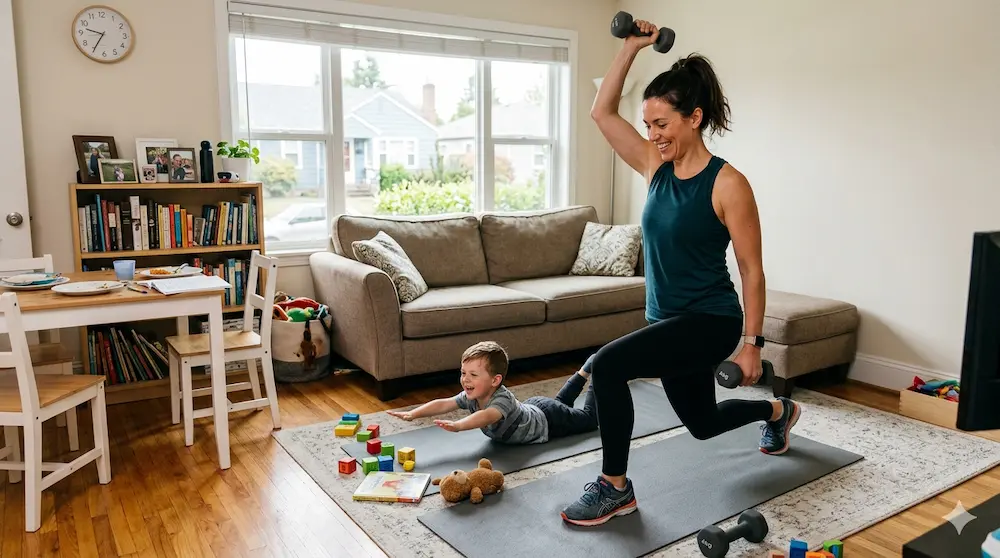
You’ve got school drop-offs, meal prep, laundry, bedtime routines — and zero time for yourself. Finding a solid 45‑minute workout block feels like a fantasy when you’re raising kids alone. The good news? you don’t need a gym or an hour of silence. Modern exercise science shows that short, frequent movement “snacks” add up to real health benefits.
The real barrier isn’t time — it’s the belief that exercise has to look a certain way. Once you let go of the “all or nothing” mindset, movement becomes something you weave into your already‑packed day, not another task on your list.
💡 This guide breaks down six realistic strategies that actually work for single parents — no equipment, no guilt, and no extra childcare required.
📋 Table of Contents
- ⏰ The Reality Check: Why “No Time” Is Not the Enemy
- 🏃♀️ Micro‑Workouts That Actually Work (3–7 Minutes)
- 🧹 Turn Parenting Chores Into Movement
- 👧 Kid‑Friendly Workouts (No Babysitter Needed)
- ⏱️ The 10‑Minute Rule: Consistency Over Intensity
- 🧠 Overcoming Mental Barriers and Parent Guilt
- ❓ Frequently Asked Questions
⏰ The Reality Check: Why “No Time” Is Not the Enemy
Let’s be honest. Between managing your kids’ schedules, keeping the household running, and possibly working a job, the idea of “finding time to exercise” can feel like a bad joke. The World Health Organization (WHO, 2022) recommends at least 150 minutes of moderate‑intensity physical activity per week — but that doesn’t have to happen in one chunk. Turns out, breaking it into short bursts of 5–10 minutes offers similar cardiovascular and mental health benefits.
So what’s really stopping you? Often it’s not the clock — it’s the mental load. You’re exhausted, and the last thing you want is another obligation. Plus, many single parents carry guilt about taking time for themselves. That’s completely normal, but worth reframing: a healthier, less stressed parent shows up better for their kids.
A 2023 analysis in the British Journal of Sports Medicine found that even 11 minutes of daily moderate activity lowers the risk of early death by nearly 20%. That’s less than the time it takes to fold one basket of laundry. The key is to stop waiting for a perfect 90‑minute window that never comes. Exercise for busy single parents isn’t about discipline — it’s about designing your day differently.
If you’re unsure where to start, ask yourself: “What’s one 3‑minute block I can claim today?” The answer might be while your coffee brews or during a child’s online lesson. That small shift changes everything.
“Have you skipped movement because you couldn’t get a full hour?” + “Do you often feel too tired to start?”
If either sounds familiar, try just two minutes of stretching right now — momentum builds from tiny wins.
🏃♀️ Micro‑Workouts That Actually Work (3–7 Minutes)
Micro‑workouts are exactly what they sound like: ultra‑short exercise sessions performed multiple times a day. The research is clear — three 5‑minute bursts of brisk walking or bodyweight moves are as effective for metabolic health as one 15‑minute continuous session. Here’s how to build them into your single‑parent schedule without extra planning.
Try this 3‑minute “anywhere” routine: 30 seconds of high knees, 30 seconds of squats, 30 seconds of push‑ups against a wall, 30 seconds of lunges, then repeat once. No equipment, no floor required. Do it while your child brushes their teeth or waits for the microwave to beep. That’s it.
Another approach is the “commercial break” workout — if your kids watch any screen time, use those 2‑3 minute ad breaks to move. Jumping jacks, running in place, or even dancing to the theme song. A single parent in Australia told a fitness survey (2024) that this habit alone added up to nearly 60 minutes of weekly exercise without feeling like a workout.
From experience, the hardest part is remembering to do it. So set three alarms on your phone labeled “move for 3 min.” When the alarm goes off, don’t negotiate — just stand up and start. The “don’t think, just do” rule works wonders for exhausted parents.
“Have you walked up and down stairs today?” + “When did you last do 10 squats?”
If it’s been more than a day, try one set of 10 squats before your next shower — that’s a micro‑workout done.
🧹 Turn Parenting Tasks Into Movement
You’re already moving constantly as a single parent — picking up toys, carrying groceries, chasing a toddler. The trick is to elevate those daily actions into purposeful exercise without adding extra time. This is called “habit stacking” — attaching a fitness move to an existing chore.
For example: every time you pick up laundry from the floor, do five deep squats before standing up. While waiting for the bath to fill, hold a wall sit for 30 seconds. When you’re carrying your child (if they’re still small), do walking lunges across the living room — they’ll likely giggle and ask for more. That’s a core and leg workout disguised as play.
Here’s a table of easy swaps:
That said, don’t force it. The goal is adding 10–15 accumulated minutes through tasks you already do, not creating new chores. One Canadian single father shared online that he now does push‑ups while his kids brush their teeth — two minutes, twice a day. Within a month, he noticed real upper‑body improvement.
“Do you stand still while waiting for coffee or the bus?” + “Do you sit while folding laundry?”
If you answered yes, today, stand on one leg while brushing your teeth — balance work counts as exercise.
👧 Kid‑Friendly Workouts (No Babysitter Needed)
One of the biggest hurdles for single parents is exercising without childcare. The solution? Include your kids. It won’t look like a gym workout, but it will keep you moving and set a healthy example for them. Plus, burning off their energy makes bedtime easier — a win‑win.
Try a “follow the leader” game where you take turns doing silly moves: frog jumps, bear crawls, or spinning in place. For older kids, set up a 10‑minute obstacle course using pillows, chairs, and jump ropes. You go through it with them — that’s your cardio.
If your child is a baby or toddler, wear them in a carrier and walk briskly around the block or up and down stairs. The added weight increases intensity. Many single parents report that stroller walks become their main form of exercise — and a 20‑minute walk three times a week meets WHO’s minimum guidelines.
YouTube also has dozens of “family workout” videos designed for parents and kids together. Search for “cosmic kids yoga” or “PE with Joe” — both are free and require zero equipment. Even 8 minutes of dancing to a kids’ song playlist gets your heart rate up.
“Have you ever turned on music and danced with your kids?” + “Do you have a stroller you use weekly?”
If not, today, put on one song and dance for the full 3 minutes — that’s a valid workout.
⏱️ The 10‑Minute Rule: Consistency Over Intensity
Here’s the mindset shift that actually works: commit to just 10 minutes of movement per day. Not an hour. Not even 20 minutes. Ten minutes. Research from the University of Bath (2023) found that people who set a “tiny” daily goal were 2.5 times more likely to stick with exercise long‑term compared to those who aimed for 30+ minutes.
Why? Because 10 minutes feels doable even on your worst days. You can always spare 10 minutes — before the kids wake up, during their screen time, or right after putting them to bed. And here’s the secret: once you start, you often keep going. But if you don’t, 10 minutes still counts. The bar is so low you can’t fail.
Create a “10‑minute menu” of options so you don’t have to decide: brisk walk around the block, a YouTube dance video, three rounds of squats/lunges/push‑ups, or climbing stairs in your building. Rotate them so it doesn’t get boring. A single mother in the UK reported in a 2024 wellness survey that this rule helped her lose 10 pounds over 6 months — not because she worked out hard, but because she never missed a day.
That said, don’t fall into the trap of thinking “10 minutes isn’t worth it.” That’s exactly the all‑or‑nothing thinking that keeps you stuck. Ten minutes of brisk walking burns roughly 50–70 calories, improves blood flow, and releases endorphins. Over a month, that’s over 1,500 extra calories burned without any extra time sacrifice.
“Do you have a 10‑minute gap anywhere today?” + “Could you wake up 10 minutes earlier?”
If you found one, block it in your calendar right now and label it “my 10‑minute move.”
🧠 Overcoming Mental Barriers and Parent Guilt
The biggest obstacle isn’t your schedule — it’s what you tell yourself. Guilt is the #1 reported barrier among single parents who don’t exercise, according to a 2022 study in Psychology of Sport and Exercise. You might feel selfish for taking even 10 minutes away from your kids, or you’re so drained that moving feels impossible. Both are valid, but both can be reframed.
Let’s tackle guilt first: You’re not abandoning your children by exercising. You’re modeling self‑care, resilience, and the truth that parents have needs too. Kids who see their parent prioritize health are more likely to adopt healthy habits themselves. So that 10‑minute workout is parenting, not selfishness.
As for exhaustion: low‑energy days call for gentle movement — stretching, slow walking, or lying down leg lifts. You don’t need to sweat or feel the burn. The only rule is to do something. Often, five minutes of gentle movement actually gives you more energy than resting. Try this: next time you feel too tired, do five minutes of slow yoga stretches on your living room floor. I’ve seen countless parents report that this small act breaks the fatigue spiral.
In my opinion, the most powerful tool is tracking your “done” list instead of your “to‑do” list. At the end of each day, write down one movement win, no matter how small. “Did 10 squats while waiting for pasta to boil.” That rewires your brain to see yourself as someone who exercises — which makes future movement feel natural, not forced.
“Do you feel guilty when you take time for yourself?” + “Do you tell yourself you’re too tired to move?”
If guilt or fatigue is stopping you, set a 5‑minute timer and just stretch on the floor — that’s a victory, period.
❓ Frequently Asked Questions
Q1. What if I literally cannot find 10 consecutive minutes without a child interrupting?
A1. Then don’t aim for consecutive minutes. Do two minutes here, three minutes there. Research confirms that accumulated short bursts have the same health impact as one solid block. Let your child “join” you — even a toddler doing silly imitations counts as you moving.
Q2. Is it safe to exercise when I’m already sleep‑deprived as a single parent?
A2. Yes, with a caveat. On days of extreme exhaustion (less than 4 hours of sleep), choose gentle movement like walking or stretching. Avoid high‑intensity intervals that could increase injury risk. Listen to your body — but don’t use tiredness as a total excuse, because often light movement improves sleep quality over time.
Q3. What’s the best time of day for single parents to exercise?
A3. Whenever you can actually do it. Some parents swear by 5 AM before kids wake up. Others move during the kid’s TV show or right after dinner. There’s no “best” — only what you can sustain. Experiment for two weeks and see which window you actually use.
Q4. Do I need special equipment or gym membership?
A4. Not at all. Bodyweight exercises (squats, lunges, push‑ups, planks) are highly effective. A pair of sneakers is nice but not required. Many single parents get fit using only their living room floor and a free YouTube channel.
Q5. How do I stay motivated when I don’t see results fast?
A5. Shift your measure of success from appearance to energy and mood. Notice if you feel less stressed after a 10‑minute walk, or if you sleep better on days you moved. Those are real results. The physical changes follow consistency, not intensity.
Q6. Can I exercise with a baby who won’t be put down?
A6. Absolutely. Wear the baby in a carrier and do squats, lunges, or walk briskly. Lie on your back and do leg lifts while baby lies on your chest. Some parents use a stroller for “walking lunges” — each step forward is a lunge.
Q7. What if I have a physical limitation or injury?
A7. Consult a physiotherapist or your doctor. But generally, seated exercises (chair yoga, arm raises, seated marching) work well. Many online programs offer “adaptive” workouts for limited mobility. The key is to move within your safe range.
Q8. How can I involve older kids/teens without them rolling their eyes?
A8. Don’t call it exercise. Suggest a family walk after dinner, a weekend hike, or a dance‑off to their favorite playlist. Teens often respond to fitness challenges — like who can hold a plank longer. Make it lighthearted, not forced.
Disclaimer: The information in this post is for general informational purposes only and does not constitute medical advice. Always consult a healthcare provider before starting a new exercise routine, especially if you have any pre‑existing conditions or injuries. Individual results vary, and what works for one single parent may not work for another.