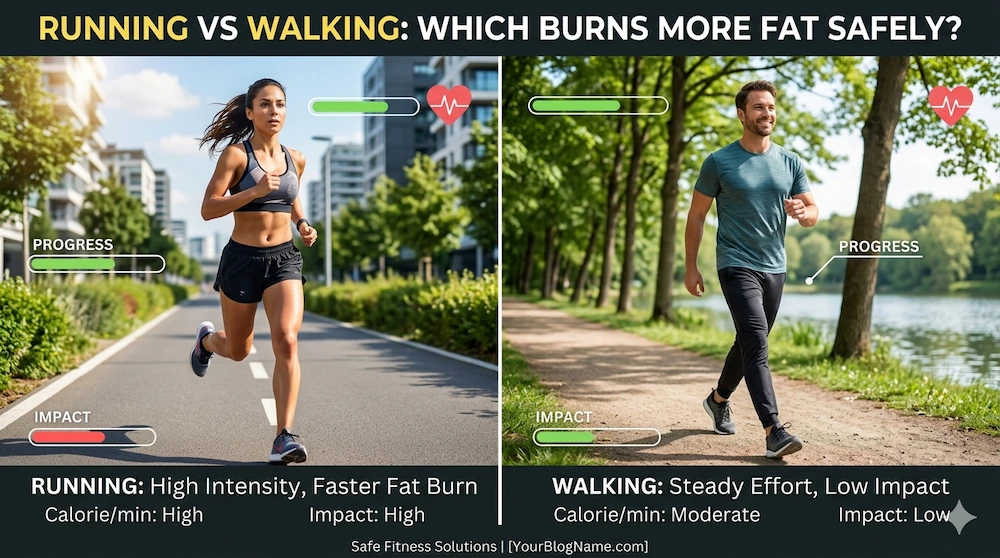
You lace up your shoes, step out the door, and face the same question every time: should you run or walk? Both are great forms of cardio, but the debate over which burns more fat safely has been ongoing for years.
The truth? The “best” choice depends on your body, your goals, and your risk tolerance — not just which one burns more calories in the moment.
💡 This guide breaks down the science behind both, the safety considerations you can’t ignore, and how to choose the right approach for sustainable fat loss.
📋 Table of Contents
- ⚖️ Running vs Walking: An Overview of Fat-Burning Potential
- 🔥 Energy Expenditure: The Calorie Burn Breakdown
- 🔄 The Afterburn Effect: EPOC and Metabolic Impact
- 🛡️ Safety First: Injury Risks and Joint Impact
- ❤️ Cardiovascular and Metabolic Health Benefits
- 📝 Which One Is Right for You? A Practical Guide
- ❓ Frequently Asked Questions
⚖️ Running vs Walking: An Overview of Fat-Burning Potential
When it comes to shedding body fat, both running and walking have their merits. However, the fat-burning potential of each depends on several factors, including intensity, duration, and your current fitness level. Running is a high-intensity activity that burns more calories per minute, but walking is a sustainable, low-impact option that can be done for longer periods.
According to a 2022 study published in the journal Medicine & Science in Sports & Exercise, running burns roughly 2.5 times more calories per minute than walking at a moderate pace. Yet, the total fat loss over time may be more comparable when you factor in injury risk and consistency. The key point is that the best exercise is the one you can stick with safely.
From experience, many people gravitate toward running because it feels like a “real” workout. But walking, especially brisk walking, is often underestimated. In my opinion, the safer choice frequently yields better long-term results, particularly for those new to exercise or returning from an injury.
“Have you had any joint pain in the past year?” + “Is your goal to lose weight or improve fitness?”
If you answered yes to the first, walking may be the safer starting point. If your goal is cardiovascular improvement, both are excellent — but one may suit you better.
🔥 Energy Expenditure: The Calorie Burn Breakdown
Let’s talk numbers. The calorie burn difference between running and walking is significant in the short term. A 160-pound person running at 5 mph (a 12-minute mile) burns approximately 606 calories per hour. The same person walking at 3.5 mph burns roughly 314 calories per hour. That’s nearly double the calories for running.
However, that’s not the whole picture. Walking burns fat directly because it’s a low-intensity activity that utilizes fat as a primary fuel source. Running, being high-intensity, relies more on carbohydrates. This is a common misconception — people think running automatically burns more fat. The truth is, you burn a higher percentage of fat during walking, but more total calories (and therefore potentially more total fat) during running.
To illustrate the comparison, here’s a breakdown for a 160-pound person performing each activity for 30 minutes, based on data from Harvard Health (2023):
🔥 Calorie Burn Comparison: Running vs. Walking
So, running clearly wins on energy expenditure per minute. But if you can walk for 60 minutes without issue, but can only run for 20 minutes due to fatigue or injury risk, the total calorie burn may equalize. That’s where the “safely” part of our question becomes critical. If you’re unsure which is right, check with your doctor or a physical therapist to get a personalized assessment.
“Can you comfortably walk for 30 minutes without pain?” + “How much time can you dedicate to exercise daily?”
If you have more time, walking can be just as effective as running for total fat loss — and it’s kinder on your joints. If you’re time-poor, running offers a higher calorie burn in a shorter window.
🔄 The Afterburn Effect: EPOC and Metabolic Impact
One of the most compelling arguments for running is the afterburn effect, known scientifically as excess post-exercise oxygen consumption (EPOC). After a high-intensity workout like running, your body continues to burn calories at an elevated rate for hours. Walking, being moderate intensity, generates a much smaller EPOC.
According to a 2021 review in the Journal of Applied Physiology, the EPOC effect from running can add an extra 10–15% to your total daily calorie burn. That means a 300-calorie run could result in an additional 30–45 calories burned just from recovery. Over weeks and months, this can significantly impact fat loss.
However, walking has its own metabolic advantage. It’s easier to do daily without needing recovery days. This consistency adds up. Walking 5 days a week for 45 minutes burns about 1,200 calories total. Running 3 days a week for 30 minutes burns around 1,000 calories. The difference is smaller than you might think, especially when you factor in the lower injury risk and greater adherence to a walking routine.
That said, if you’re looking to boost your metabolism and have no joint issues, running is a potent tool. But don’t discount walking — it’s a reliable, low-risk method to increase your daily energy expenditure with minimal downsides.
“Do you have 3–4 hours per week for exercise?” + “Do you prefer high-intensity or moderate workouts?”
If you have limited time, running may give you more metabolic bang for your buck. If you enjoy long, steady sessions, walking can deliver similar results with less wear and tear.
🛡️ Safety First: Injury Risks and Joint Impact
Here’s where the debate tilts. Running has a high injury rate. Estimates from the National Institutes of Health (NIH, 2023) suggest that between 30% and 80% of runners experience an injury each year. Common issues include shin splints, runner’s knee, and stress fractures. Walking, by contrast, has a much lower injury incidence — roughly 1–5% of walkers report significant injuries.
Why the difference? Impact forces. When you run, the force on your joints can be 2.5 to 3 times your body weight. When you walk, it’s about 1.2 to 1.5 times. For someone with pre-existing joint issues or a history of knee or back pain, walking is clearly the safer option. In the UK, the NHS recommends walking as a primary form of exercise for older adults and those with osteoarthritis, while suggesting running only for those with no joint concerns.
That doesn’t mean running is unsafe for everyone. With proper technique, good shoes, and a gradual increase in mileage, many people run injury-free for decades. But if you’re starting from a sedentary lifestyle, or if you’re overweight (BMI > 30), walking is almost universally recommended as the safer entry point.
Worth noting: the safest exercise is the one that gets you moving consistently. If you’re worried about injury, start with walking. If you’re comfortable with running, ensure you cross-train and listen to your body. As one physical therapist told me, “The best exercise routine is one you can do without pain.”
“Do you have any knee, hip, or back pain?” + “Have you exercised regularly in the past 6 months?”
If you have chronic pain or are new to exercise, walking is the safer, smarter place to start. You can always progress to running once you build a foundation.
❤️ Cardiovascular and Metabolic Health Benefits
Beyond fat loss, both running and walking offer profound cardiovascular benefits. According to the World Health Organization (WHO, 2022), regular physical activity reduces the risk of heart disease, stroke, and type 2 diabetes. Running tends to improve cardiovascular fitness (VO2 max) faster, but walking also provides significant protection.
A landmark study from the Journal of the American College of Cardiology (2023) found that running 5–10 minutes a day at moderate speed reduced the risk of cardiovascular disease by 45%. Walking for 30 minutes a day reduced it by 35%. The difference is smaller than the calorie burn gap suggests, meaning walking is nearly as effective for heart health as running.
From a metabolic standpoint, both improve insulin sensitivity and glucose regulation. A 2022 study in Diabetes Care found that walking after meals significantly reduced blood sugar spikes, making it an excellent choice for those with prediabetes or type 2 diabetes. Running, while effective, can sometimes cause blood sugar to drop too quickly in unmanaged conditions — another reason safety matters.
So, if your primary goal is heart and metabolic health, both are excellent. Running might give you a slight edge in efficiency, but walking is more accessible, safer, and easier to integrate into a daily routine.
“Do you have any metabolic conditions like prediabetes or high blood pressure?” + “Are you cleared for vigorous exercise?”
If you’re managing a chronic condition, consult your doctor before starting running. Walking is typically safe and highly beneficial for blood sugar control and heart health.
📝 Which One Is Right for You? A Practical Guide
So, when should you choose running, and when should you choose walking? It’s not a one-size-fits-all answer. Here’s a practical breakdown based on real-world factors:
- If you’re time-poor: Running is more efficient. A 20-minute run burns roughly the same calories as a 40-minute walk. If you have a tight schedule, running is the better choice.
- If you’re injury-prone or have joint issues: Walking wins, hands down. It’s gentler on knees, hips, and ankles. You can also increase intensity by adding hills or using a weighted vest.
- If you’re new to exercise: Start with walking. Build a base of 30–45 minutes, 4–5 days a week. Once you’re comfortable, you can introduce running intervals.
- If you want to boost metabolism: Incorporate both. Running 2–3 days a week and walking on off-days can provide the best of both worlds — high calorie burn on some days and recovery on others.
Think of it this way: running is like a powerful sprint in a marathon; walking is the steady pace that gets you to the finish line. Both have their place. From what I’ve seen, the most successful fat-loss plans are sustainable. If you dread running, you won’t stick with it. If you find walking boring, you won’t stay consistent either. So choose the one you actually enjoy.
One practical piece of advice: start with walking for 2 weeks. Then add short running intervals (e.g., 1 minute running, 3 minutes walking) and gradually increase the running time. This progressive overload reduces injury risk and makes the transition smoother.
“What’s your primary goal: fat loss, fitness, or joint health?” + “How much time can you realistically commit?”
If you’re still unsure, try both for a week. Track how you feel and how many calories you burn. The one that fits your lifestyle and keeps you pain-free is the right choice for you.
❓ Frequently Asked Questions
Q1. Which burns more belly fat: running or walking?
A1. Neither exercise specifically targets belly fat. Fat loss is systemic. However, running burns more total calories per minute, which can lead to greater overall fat loss, including abdominal fat, if you maintain a calorie deficit. Walking, done consistently, can also be highly effective.
Q2. Is walking enough to lose weight, or do I need to run?
A2. Walking is absolutely enough for weight loss if you do it consistently and manage your diet. Many people successfully lose weight walking 45–60 minutes a day, 5 days a week. The key is maintaining a calorie deficit.
Q3. How many calories does running vs walking burn per mile?
A3. A general rule of thumb is that you burn roughly 100 calories per mile, regardless of speed, for a 160-pound person. So, running a mile burns about 100 calories, and walking a mile burns about 90–100 calories. The difference isn’t huge per mile, but running takes less time.
Q4. Is walking or running better for knee health?
A4. Walking is widely considered better for knee health because it places less stress on the joint. Running can be safe for healthy knees, but if you have osteoarthritis or previous knee injuries, walking is the recommended choice.
Q5. Can I alternate between running and walking?
A5. Absolutely. This approach, known as walk/run intervals, is a great way to build endurance, reduce injury risk, and still get a high-calorie burn. It’s especially popular among beginners and those returning from injury.
Q6. What’s better for mental health: running or walking?
A6. Both have mental health benefits. Running provides a stronger “runner’s high” due to endorphin release, but walking reduces cortisol and improves mood in a gentler way. The best choice is whichever you find more enjoyable and can maintain regularly.
Q7. Does walking burn fat or muscle?
A7. Walking is a low-intensity exercise that primarily burns fat for fuel. Running, being high-intensity, burns more carbohydrates but also burns fat over time. Neither will burn significant muscle unless you are in a severe calorie deficit without adequate protein.
Q8. Can I lose weight by walking 10,000 steps a day?
A8. Yes, walking 10,000 steps (roughly 5 miles) burns about 400–500 calories for most people. Combined with a healthy diet, this can lead to a weight loss of about 1 pound per week. It’s a safe and sustainable goal for most adults.
Disclaimer: The information in this post is for general informational purposes only and reflects guidelines available as of 2025. Physical activity recommendations and health outcomes vary by individual. Always consult a healthcare professional before starting a new exercise routine, especially if you have pre-existing health conditions. This post does not constitute medical, legal, or financial advice.
