You’ve passed 50, and maybe you’re noticing that your body doesn’t bounce back the way it used to. That morning stiffness lasts longer. Your balance isn’t quite what it was. But here’s the good news: starting a fitness routine at this stage can add years of independence and energy — and it’s safer than you think.
The biggest mistake most beginners over 50 make? Jumping in too hard, too fast. That leads to soreness, injury, and quitting within two weeks. The truth is, a well-designed beginner’s fitness guide for people over 50 focuses on consistency, not intensity.
💡 This guide walks you through exactly where to start — from medical clearance to weekly routines — so you can build strength and confidence without fear of injury.
📋 Table of Contents
- 🌟 Why Fitness Matters After 50 (It’s Not Just About Weight)
- 🩺 Medical Clearance & Realistic Goal Setting
- 🏃♀️ The 4 Essential Types of Exercise for Over-50 Beginners
- 📅 A Simple Weekly Routine You Can Start Tomorrow
- ⚠️ 5 Common Mistakes That Derail Beginners Over 50
- 🔥 Staying Motivated & Tracking Progress Without Obsessing
- ❓ Frequently Asked Questions
🌟 Why Fitness Matters After 50 (It’s Not Just About Weight)
Let’s be honest — the idea of starting a beginner’s fitness guide for people over 50 can feel intimidating. You might worry about hurting a knee or looking out of place. But here’s what decades of research show: regular physical activity after 50 is one of the strongest predictors of healthy aging. It’s not about fitting into smaller jeans. It’s about being able to carry groceries, play with grandkids, and live independently for longer.
According to the World Health Organization (WHO, 2020), adults aged 65 and older who engage in at least 150 minutes of moderate-intensity aerobic activity per week have a 30% lower risk of falls and a significantly reduced rate of cognitive decline. The key is starting where you are — not where you think you “should” be. A beginner’s fitness guide for people over 50 isn’t about pushing limits; it’s about building a foundation.
That said, the benefits go beyond the physical. Regular movement improves sleep, reduces anxiety, and helps manage chronic conditions like high blood pressure and type 2 diabetes. In my opinion, the most underrated benefit is the sense of control — knowing that you’re actively investing in your future self. So if you’ve been sedentary for a while, don’t let guilt stop you. Every minute of movement counts.
“Can you walk up one flight of stairs without chest pain or severe breathlessness?”
If yes, you’re ready to start a low-intensity routine. If no, speak with your doctor first — there may be underlying issues to address before you begin.
🩺 Medical Clearance & Realistic Goal Setting
Before you lace up those sneakers, let’s talk about the one step most people skip: getting medical clearance. This doesn’t mean you need permission to move. But if you have a history of heart disease, joint replacements, uncontrolled diabetes, or high blood pressure, a quick chat with your doctor can prevent serious complications. The same goes if you’ve been completely inactive for over a year. A proper beginner’s fitness guide for people over 50 always starts with safety.
Your doctor might recommend a stress test or refer you to a physical therapist for baseline mobility screening. In countries like Canada and Australia, many family physicians can provide a “exercise prescription” — a written plan tailored to your health conditions. The UK’s NHS also offers referral schemes to free or low-cost exercise programs for older adults. Don’t be shy about asking. Once you have the green light, it’s time to set goals that actually stick.
Here’s where most people go wrong: They set vague or unrealistic goals like “get fit” or “lose 20 pounds.” Instead, try SMART goals — Specific, Measurable, Achievable, Relevant, and Time-bound. For example: “I will walk for 15 minutes after lunch, three days this week.” That’s small enough to feel easy, but consistent enough to build momentum. Celebrate the completion, not just the outcome.
“Have you had any joint replacement, heart procedure, or fall in the past 12 months?”
If yes, do not start a routine without a physiotherapist or doctor input. Modified exercises are available, but they need to be specific to you.
🏃♀️ The 4 Essential Types of Exercise for Over-50 Beginners
A complete beginner’s fitness guide for people over 50 includes four components: aerobic, strength, balance, and flexibility. Ignoring any one of them leaves gaps in your health. Let’s break each down in plain terms.
Aerobic (endurance): This is anything that gets your heart rate up slightly — walking, swimming, cycling, or dancing. The goal isn’t to be breathless. You should be able to talk in short sentences. Start with 5–10 minute sessions and add one minute each week.
Strength training: Loss of muscle mass accelerates after 50 — about 3–8% per decade. But resistance exercises reverse that. You don’t need heavy weights. Bodyweight squats, wall push-ups, and resistance bands work perfectly. Aim for two sessions per week, with a day of rest in between.
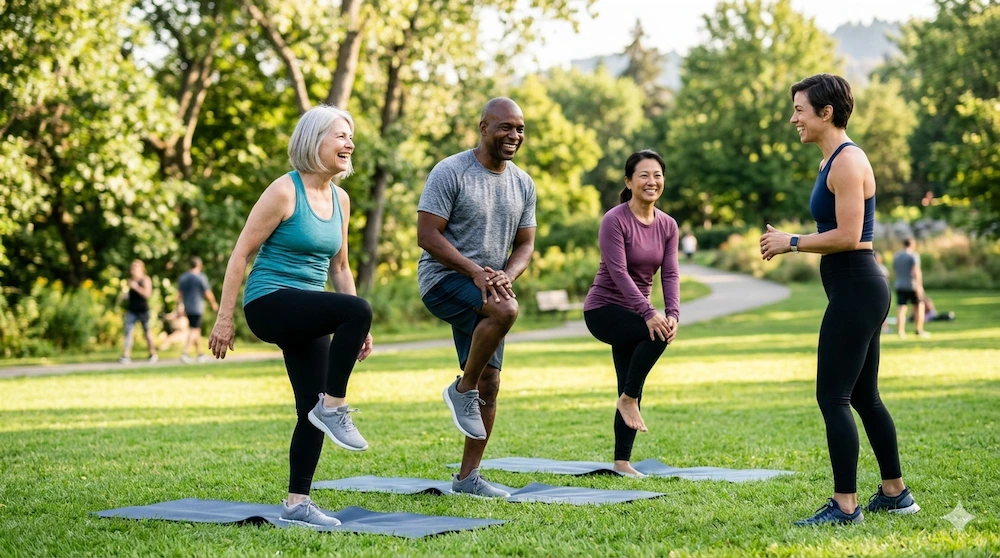
Balance exercises: This is the unsung hero of fall prevention. Simple moves like standing on one foot (hold the back of a chair) or heel-to-toe walking train your proprioception. Just two minutes of balance work per day can cut fall risk significantly.
Flexibility: Tight hips and shoulders are common after 50. Static stretching after your workout — hold each stretch for 20–30 seconds — keeps your joints mobile. Yoga or tai chi classes designed for older adults combine flexibility with balance.
Worth noting: Many community centers in Germany, Japan, and the US offer “Silver Sneakers” or similar subsidized programs. Check with your local senior services or health authority — you might have free access already.
“Can you stand on one leg for 10 seconds without holding onto anything?”
If not, prioritize balance exercises — start with support, and within a few weeks you’ll see improvement.
📅 A Simple Weekly Routine You Can Start Tomorrow
Let’s make this practical. Below is a sample week for someone following a beginner’s fitness guide for people over 50. It assumes you’ve been cleared by a doctor and have no acute injuries. Adjust the duration based on how you feel — less is fine, more is not better initially.
Notice there’s no “all-or-nothing” day. The goal is to move your body on most days, even if just for 10 minutes. If you miss a day, don’t try to double up the next day. That’s how injuries happen. Just resume the plan as written. Consistency over perfection — that’s the real secret of any beginner’s fitness guide for people over 50.
“Which two days this week can you realistically set aside 15 minutes for yourself?”
Write them down. Even one 15-minute session is a win — don’t underestimate the power of starting small.
⚠️ 5 Common Mistakes That Derail Beginners Over 50
Even with the best intentions, certain patterns can sabotage your progress. Let’s flag them now so you can avoid the frustration.
1. Doing too much too soon. That “no pain, no gain” mindset is dangerous after 50. Soreness that lasts more than 48 hours or sharp joint pain means you overdid it. A proper beginner’s fitness guide for people over 50 emphasizes gradual progression. Add no more than 10% total volume per week.
2. Skipping warm-ups and cool-downs. Your connective tissues need longer to prepare. Five minutes of easy movement before exercise and gentle stretching after can prevent strains. This isn’t optional — it’s essential.
3. Ignoring pain vs. discomfort. Muscle fatigue is fine. Aching in a joint (knee, hip, shoulder) is a stop sign. Learn the difference. If it hurts, modify or skip that move.
4. Comparing yourself to younger versions of you. You might have run marathons at 35. That’s a different body. Let go of past benchmarks and focus on what you can do today, without judgment.
5. Not hydrating or resting enough. Recovery is part of training. Sleep quality often dips after 50, so prioritize 7–8 hours. Drink water before, during, and after exercise — thirst sensation decreases with age.
Turns out, most injuries in older beginners come from ego, not effort. Listen to your body. It’s been keeping you alive for five decades — trust it.
“Have you felt any sharp, localized pain during or after movement in the past week?”
If yes, take two rest days and see a physiotherapist if it persists. Pushing through sharp pain can turn a mild issue into a long-term problem.
🔥 Staying Motivated & Tracking Progress Without Obsessing
Motivation isn’t something you find — it’s something you build. The first few weeks of any beginner’s fitness guide for people over 50 can feel like a chore. That’s normal. The key is to create small rewards and visible tracking that doesn’t become obsessive.
Instead of weighing yourself every day (which fluctuates for countless reasons), track behavioral wins: how many days you walked, how your sleep improved, or how much easier it is to get up from a chair. Use a simple paper calendar or a free app like Strava (set to private). The act of checking off a box is surprisingly satisfying.
Another powerful strategy is finding an accountability partner. Studies from the University of Aberdeen (2022) show that older adults who exercise with a buddy are 42% more likely to stick with a routine after three months. That could be a neighbor, a sibling, or an online community. Many regions offer walking groups through local health services — for instance, “Walking for Health” in the UK or “Walk with a Doc” in various US cities.
Finally, be kind to yourself on low-energy days. Ask: “Can I do just five minutes of gentle stretching?” Usually, once you start, you’ll do more. But if you genuinely can’t, rest without guilt. Long-term adherence beats short-term intensity every time.
“What’s one non-scale victory you’d love to achieve in the next month?”
Write it down and post it on your fridge. Examples: “Walk 10 minutes without stopping” or “Touch my toes while seated.”
❓ Frequently Asked Questions
Q1. Is it safe to start exercising after 50 if I’ve never really worked out before?
A1. Absolutely — as long as you get medical clearance first. Many people begin their fitness journey after 50. Start with low-impact activities like walking or water exercises, and progress slowly. A beginner’s fitness guide for people over 50 is designed exactly for this scenario.
Q2. How long before I see results like better energy or less joint pain?
A2. Most people notice improved sleep and mood within 2–3 weeks. Joint pain relief and strength gains typically take 6–8 weeks of consistent effort. Don’t expect overnight changes — the real transformation happens over months.
Q3. What if I have arthritis or a bad knee — can I still follow this guide?
A3. Yes, but you’ll need modifications. For example, swap walking for cycling or swimming. Avoid deep squats or high-impact moves. A physical therapist can give you a personalized version. Many countries offer subsidized physio consultations for older adults — check with your local health authority.
Q4. Do I need special equipment or a gym membership?
A4. Not at all. A pair of supportive sneakers is the only essential. Resistance bands are cheap (under $10) and highly effective. Bodyweight exercises work fine for the first several months. Gyms are optional.
Q5. How do I know if I’m pushing too hard?
A5. Use the “talk test”: during aerobic exercise, you should be able to speak a full sentence without gasping. For strength, you should complete the last rep with good form but feel like you could do one more. Sharp pain, dizziness, or nausea are stop signals.
Q6. Can I combine this guide with a weight-loss diet?
A6. Yes, but don’t cut calories drastically. After 50, your protein needs increase (about 1.2–1.5g per kg of body weight). Focus on whole foods and adequate hydration. Consult a registered dietitian if you have diabetes or other metabolic conditions.
Q7. What’s the best time of day to exercise for someone over 50?
A7. Whenever you’ll actually do it. That said, afternoon workouts (1–4 pm) often align with natural body temperature peaks and may feel easier on stiff morning joints. Experiment to find your rhythm.
Q8. How do I restart after a break of several weeks due to illness or travel?
A8. Drop back to 50–70% of your previous duration and intensity. For example, if you were walking 30 minutes, start with 15–20 minutes. Give yourself one week to ramp back up. There’s no shame in resetting — the body remembers, but gently.
Disclaimer: This beginner’s fitness guide for people over 50 is for general informational purposes only and does not replace professional medical advice. Always consult your doctor or a qualified healthcare provider before starting any new exercise program, especially if you have pre-existing conditions or have been sedentary. Individual responses to exercise vary. The author and publisher disclaim any liability for injuries or health issues arising from the use of this information.