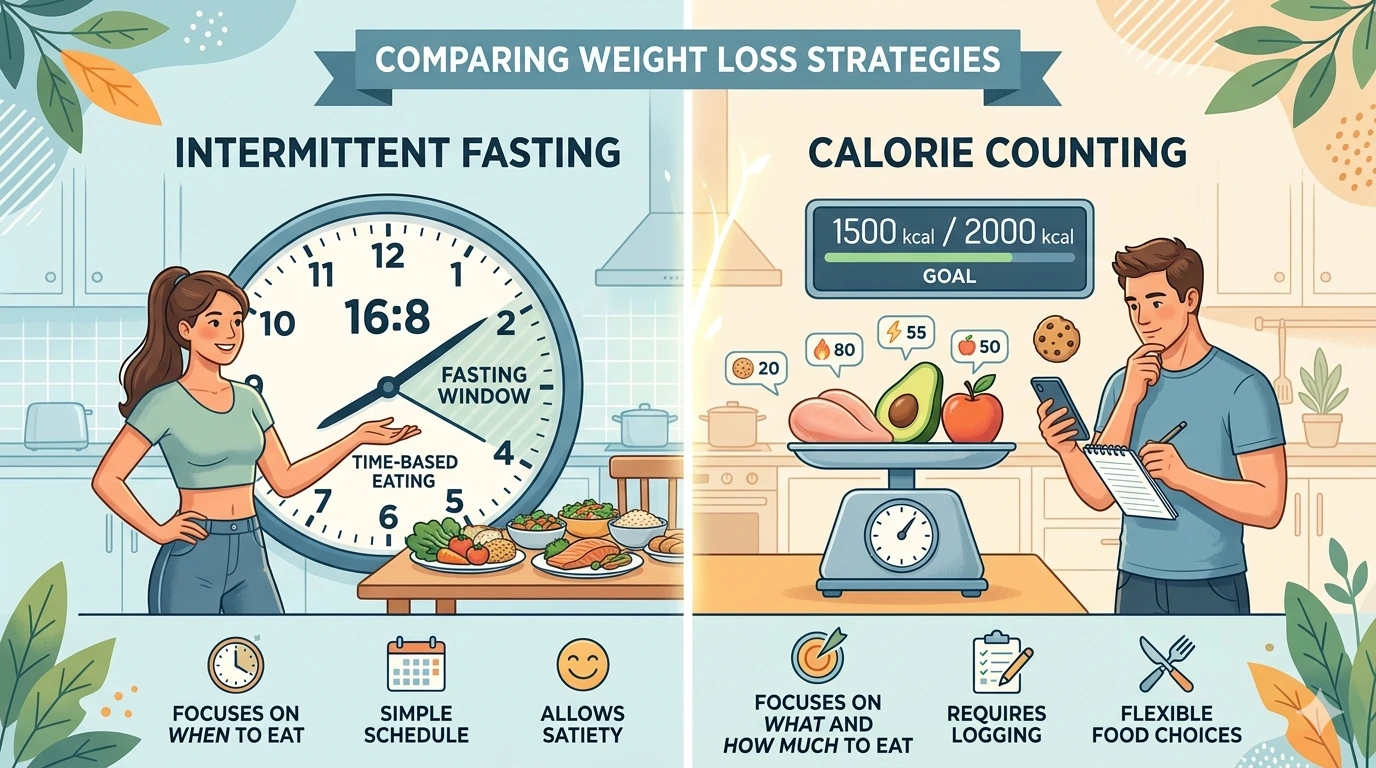
You’ve probably seen both strategies all over social media: intermittent fasting promises simpler rules and better metabolic flexibility. Calorie counting claims precision and no food restrictions. So which one actually helps you lose weight and keep it off?
The truth? Both can work — but they work very differently. Your personality, daily schedule, and even your gut health can make one far more effective for you than the other.
💡 This review breaks down the science behind both approaches — and helps you decide which one fits your real life.
📋 Table of Contents
- 🔍 Intermittent Fasting vs Calorie Counting: An Overview
- ⏳ How Intermittent Fasting Works (Plus Key Benefits)
- 📊 How Calorie Counting Works (Plus Key Benefits)
- ⚖️ Head-to-Head: Weight Loss, Hunger & Adherence
- 🫀 Metabolic Health and Long‑Term Effects
- 🧘 Which One Fits Your Lifestyle? Practical Tips
- ❓ Frequently Asked Questions
🔍 Intermittent Fasting vs Calorie Counting: An Overview
Over the past decade, intermittent fasting (IF) has exploded in popularity — from the 16:8 method to alternate-day fasting. Meanwhile, calorie counting remains the traditional backbone of most weight loss programs. According to the World Health Organization (2024), more than 1 billion people globally are living with obesity. That urgency drives millions to try one — or both — of these approaches.
The key difference? IF focuses on when you eat, while calorie counting focuses on how much. But recent research suggests the real winner may depend on individual factors like hunger hormones, lifestyle consistency, and even your work schedule.
A systematic review published in JAMA Network Open (2023) compared both methods across 12 randomized trials. The conclusion: average weight loss is similar after 6–12 months, but adherence rates differ significantly. That’s where things get interesting.
So let’s move beyond the hype. Here’s what the evidence actually says — and how to choose the path you’ll actually stick with.
“Have you tried dieting before and felt constantly hungry?” + “Do you prefer clear rules or flexible tracking?”
Your answers will strongly predict which method works better for you. Take note of them before reading on.
⏳ How Intermittent Fasting Works (Plus Key Benefits)
Intermittent fasting isn’t a diet — it’s an eating pattern that cycles between periods of eating and fasting. The most common version is 16:8 (fast for 16 hours, eat within an 8-hour window). Others include 14:10, 5:2 (eat normally 5 days, restrict calories 2 days), and alternate-day fasting.
When you fast for extended hours, your body depletes glucose stores and shifts to fat burning. That metabolic switch typically happens around 12–16 hours. During this state, levels of insulin drop significantly, which allows stored fat to be used as energy.
What’s the evidence? A 2022 trial in Cell Metabolism followed 90 adults with obesity over 12 months. The 16:8 group lost 5–7% of body weight on average — similar to daily calorie restriction. But the IF group showed better improvements in insulin sensitivity and lower oxidative stress markers.
Benefits many people report: fewer meals to plan, no need to track every bite, and natural calorie reduction without conscious effort. That said, IF isn’t for everyone. People with a history of eating disorders, those who are underweight, pregnant women, and individuals on certain diabetes medications should consult a doctor before trying extended fasting.
Worth noting: The first week can be rough — hunger pangs, irritability, and trouble sleeping are common. Most people adapt within 10–14 days. In my opinion, IF shines for those who prefer big, satisfying meals over frequent small ones.
“Do you usually skip breakfast without feeling terrible?” + “Do you like eating until you’re fully satisfied?”
If yes, intermittent fasting may feel more natural to you than calorie counting. Try a 14:10 schedule for the first week.
📊 How Calorie Counting Works (Plus Key Benefits)
Calorie counting is straightforward: track everything you eat and drink, stay below a daily target (usually 500–700 calories below maintenance), and weight loss follows. The target varies by age, sex, activity level, and goals. For many adults, that’s roughly 1,500–1,800 calories per day for weight loss.
Why does it work? Because calories in, calories out remains the fundamental law of energy balance. A study from Obesity Reviews (2023) analyzed 35 trials and found that any diet producing a calorie deficit leads to weight loss — regardless of macros or timing. Counting gives you precise control.
The biggest upside: no food is off-limits. You can have pizza, chocolate, or wine — just fit it into your budget. That flexibility reduces feelings of deprivation for many people. Plus, calorie counting teaches portion awareness and nutritional literacy that lasts long after you stop tracking.
Downsides? It can become obsessive. Tracking every gram, weighing portions, and logging apps may trigger unhealthy relationships with food. According to a 2024 survey by the UK Eating Disorders Charity Beat, 28% of regular calorie trackers reported increased anxiety around meals. Another challenge: accuracy is hard — restaurant meals, home cooking, and human error can create 20–30% calorie misestimation.
From what I’ve seen, calorie counting works best for people who enjoy data, don’t mind daily logging, and want to understand exactly what goes into their body. It’s also essential for athletes or those with specific body composition goals where precision matters.
“Do you enjoy using apps and tracking data?” + “Do you eat out or cook mostly at home?”
If you love detail and cook at home often, calorie counting gives you superpowers. Start with a 3-day food diary before setting a target.
⚖️ Head-to-Head: Weight Loss, Hunger & Adherence
This is where the rubber meets the road. A 2023 meta-analysis in The American Journal of Clinical Nutrition pooled data from 23 randomized trials comparing intermittent fasting to traditional calorie restriction. After 6 months, the average weight loss difference was less than 1 kg — essentially a tie.
However, when researchers looked at dropout rates, IF showed a slight advantage: 28% vs 35% for calorie counting. That suggests people find fasting slightly easier to stick with long-term. But why?
Turns out, hunger hormones behave differently with each method. A small but insightful University of Illinois Chicago study (2023) measured ghrelin (the “hunger hormone”) in IF vs calorie counters. IF participants had lower ghrelin spikes after the first week, while calorie counters experienced consistent daily surges before meals.
That said, some people find fasting impossible due to work schedules, medication timing, or blood sugar regulation. Calorie counting offers more flexibility — you can eat every 3 hours if needed. The key point is: neither is objectively superior in weight loss; the winner is the one you can do consistently.
“Have you failed to stick with a diet before because it felt too restrictive?”
If yes, try the method that feels less restrictive to you — not the one that looks better on paper. Consistency always beats intensity.
🫀 Metabolic Health and Long‑Term Effects
Weight loss numbers only tell part of the story. What about blood sugar, cholesterol, inflammation, and longevity markers? Here, intermittent fasting may have a slight edge — at least based on current research.
A 2024 systematic review in The Lancet Diabetes & Endocrinology examined metabolic outcomes across 18 IF trials. Results: IF consistently reduced fasting insulin by 15–25% more than equivalent calorie restriction. It also lowered IGF-1 (a growth factor linked to aging) by about 10%.
Why? Fasting triggers autophagy — a cellular cleanup process that removes damaged components. Calorie restriction alone doesn’t produce the same magnitude of autophagy unless the fasting window exceeds 16 hours. That said, the long-term clinical significance of increased autophagy in humans is still debated.
For calorie counting, metabolic benefits are largely driven by weight loss itself. If you lose 5–10% of body weight through any method, you’ll see improvements in blood pressure, LDL cholesterol, and HbA1c. A 2023 UK Biobank analysis (n=82,000) found that sustained calorie reduction of 300 calories/day was associated with a 12% lower risk of type 2 diabetes — regardless of eating window.
Worth noting: Both methods require high-quality food choices for best results. Fasting but eating ultra-processed foods during your window won’t deliver metabolic magic. Similarly, counting calories but living on protein bars and diet soda misses the fiber and nutrients that drive long-term health.
“Do you have prediabetes or metabolic syndrome?”
If yes, intermittent fasting might offer additional insulin-sensitizing effects. But check with your doctor first — medication timing matters.
🧘 Which One Fits Your Lifestyle? Practical Tips
Here’s the truth that most articles skip: your personality, schedule, and emotional relationship with food matter more than the science. Let’s break down which approach suits different scenarios.
Choose intermittent fasting if: You hate tracking and weighing food. You naturally skip breakfast without suffering. Your work or social life allows a later first meal. You prefer eating two larger, satisfying meals over six small ones. You want to reduce snacking without feeling deprived.
Choose calorie counting if: You enjoy data and don’t mind logging. You have an unpredictable schedule (shift work, frequent travel) that makes fixed eating windows hard. You’re an athlete needing precise fueling. You’ve struggled with fasting-induced headaches or irritability. You want to learn portion control for life.
A hybrid approach also works: track calories loosely while eating within a 12-hour window. Many successful long-term maintainers combine gentle time restriction (12:12 or 14:10) with mindful portion awareness. That gives you the insulin benefits of a fasting window without the rigidity of pure IF or the tedium of strict counting.
One practical tip from registered dietitians: try each method for two weeks. Keep a simple journal of hunger, energy, mood, and how much mental effort it takes. The method that scores best on “ease” is your long-term winner. Weight lost quickly but regained is worthless — so prioritize sustainability.
Finally, remember that neither approach works if you’re eating nutrient-poor food. A 2024 WHO report on healthy diets emphasized that regardless of timing or calorie targets, increasing vegetables, lean protein, and whole grains remains the foundation of metabolic health.
“Are you ready to start today?”
Pick one method for 14 days. Commit to just that — no switching back and forth. After two weeks, decide if it feels natural or if you need the other approach.
❓ Frequently Asked Questions
Q1. Is intermittent fasting better than calorie counting for belly fat?
A1. Research is mixed. A 2023 study in Obesity found IF led to slightly greater visceral fat loss (about 8% more than calorie counting), but other trials show no difference. Both reduce belly fat effectively when you lose total body weight.
Q2. Can I combine intermittent fasting and calorie counting?
A2. Absolutely — many people do. Use a 16:8 or 14:10 window and loosely track calories to avoid overeating during the eating window. Just be careful not to become obsessive. The combo works well for plateau busting.
Q3. Does intermittent fasting cause muscle loss?
A3. In short-term studies (up to 6 months), muscle loss is similar to calorie counting — roughly 15–25% of weight lost may come from lean mass. However, if you eat adequate protein (1.6–2.2 g/kg body weight) and resistance train, both methods preserve muscle well.
Q4. How accurate are calorie tracking apps?
A4. A 2024 evaluation of popular apps (MyFitnessPal, Lose It, Cronometer) found accuracy within 10–20% for packaged foods with barcodes. For home-cooked meals, error can reach 30–40%. The value is in consistency, not perfect precision.
Q5. Which method works better for people with type 2 diabetes?
A5. Both can be effective, but IF requires careful medication adjustment. A 2023 trial in Diabetes Care showed time-restricted eating improved HbA1c by 0.6% more than daily calorie restriction. However, never start IF without your doctor’s supervision if you’re on insulin or sulfonylureas.
Q6. I feel hungry all the time on calorie counting. Should I switch to IF?
A6. Worth a try. Many people find that spreading calories across 2 meals instead of 5 reduces hunger hormones over time. Start with a 14-hour fast and see if hunger patterns change after 10 days.
Q7. Does intermittent fasting affect women differently than men?
A7. Possibly. Some research suggests women may be more sensitive to fasting stress, with potential impacts on menstrual cycle or thyroid function. A 2022 review recommended women start with shorter fasts (14:10) and avoid fasting for more than 5 days per week. Listen to your body.
Q8. How many calories should I eat if I choose calorie counting?
A8. A safe starting point: multiply your body weight in kg by 25–30 for maintenance. Subtract 300–500 for weight loss. For example, a 70 kg person: 70 × 28 = 1,960 maintenance → 1,600 calories/day for gradual loss. Adjust based on weekly weight changes.
Disclaimer: The information in this post is for general informational purposes only and reflects research available as of 2025. Individual results vary based on genetics, adherence, and overall lifestyle. Consult a physician or registered dietitian before starting any new diet or fasting regimen, especially if you have underlying health conditions or take medications. This post does not constitute medical advice.