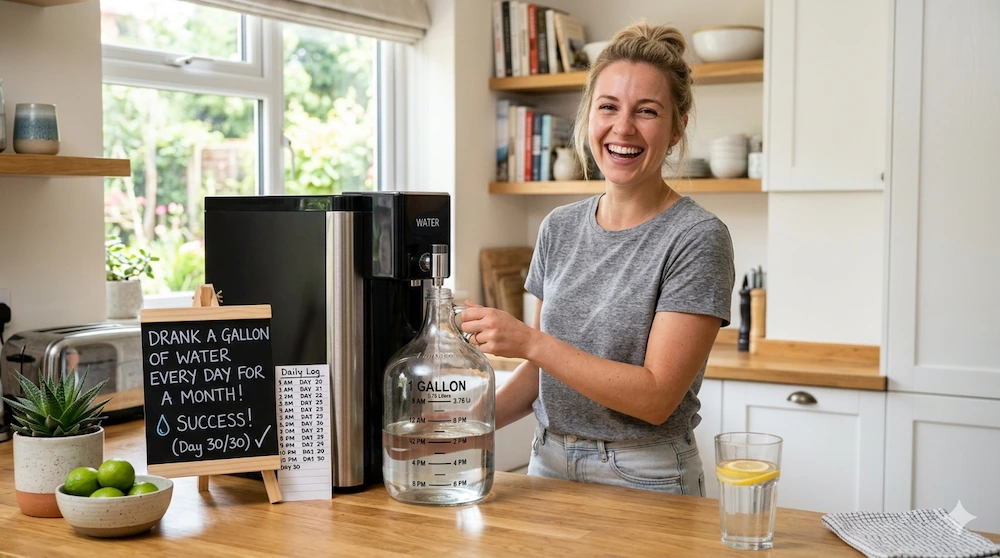
Drinking a gallon of water daily has become a popular wellness challenge — but does it actually deliver noticeable benefits, or is it just another hydration myth? I decided to test it for 30 days: exactly one gallon (about 3.8 liters) of water every single day, no exceptions.
Turns out, the results weren’t what I expected. Some changes were amazing. Others were inconvenient — and a few were genuinely worth paying attention to.
💡 The short version: Hydration matters, but a gallon isn’t for everyone. Here’s what the science says, plus my day-by-day experience so you can decide what’s right for you.
📋 Table of Contents
- 🔍 What Happens When You Drink a Gallon of Water Daily?
- ✅ My 30-Day Water Challenge: Setup and Rules
- 💪 Physical Changes I Noticed (Week by Week)
- 🧠 The Unexpected Mental and Energy Shifts
- ⚠️ Challenges, Side Effects, and Safety Warnings
- 💡 What I Learned: Is a Gallon a Day Worth It?
- ❓ Frequently Asked Questions
🔍 What Happens When You Drink a Gallon of Water Daily?
Drinking a gallon of water per day means consuming roughly 3.8 liters — significantly more than standard recommendations. According to the U.S. National Academies, adequate daily fluid intake is about 3.7 liters for men and 2.7 liters for women (including water from food). So a full gallon puts most people well above the baseline.
The theory behind the challenge is compelling: more water flushes toxins, boosts metabolism, clears skin, and improves focus. And for some people, especially those who are active or live in hot climates, higher water needs are real. But here’s what the research actually says.
A 2023 meta-analysis in Nutrients found that increasing daily water intake by 1 liter improved subjective alertness and reduced headache frequency in people who were mildly dehydrated at baseline. However, for already well-hydrated individuals, the benefits plateau quickly. The key point is that more isn’t always better — your body has a narrow window for optimal hydration.
That said, I went into this experiment with average daily intake around 2–2.5 liters. A gallon represented a 50–90% increase. So what actually changed?
“Do you often feel tired, have dry skin, or get frequent headaches?”
If yes, you might be under-hydrated. But jumping straight to a gallon could be too much — start with an extra 500ml per day and see how you feel.
✅ My 30-Day Water Challenge: Setup and Rules
To keep this experiment clean, I set a few ground rules. One gallon of plain water per day — no flavored water, no sparkling water, no teas counting toward the total. I wanted pure H2O only. I used a marked 1-gallon jug and sipped throughout the day rather than chugging.
My baseline: healthy, moderately active (walking 8–10k steps daily, light strength training 3x/week). No medications, no known kidney issues. I tracked:
- Morning and evening weight
- Urine color (using a hydration chart)
- Energy levels (1–10 scale at 9am, 1pm, 6pm)
- Skin dryness (self-assessment)
- Digestive regularity
I also measured my resting heart rate and blood pressure weekly. The goal wasn’t to prove anything dramatic — just to see what actually shifts when you force a high intake.
Worth noting: I live in a temperate climate (average 18–22°C during the month) and work a desk job. Someone in a hot, humid environment or doing endurance sports would have completely different results. Your mileage will vary — literally.
“How much water do you currently drink in a typical day?”
If it’s less than 1.5 liters, don’t jump to a gallon immediately. Increase gradually over 2–3 weeks to let your body adjust.
💪 Physical Changes I Noticed (Week by Week)
Week 1: The bathroom break shock
The most immediate change wasn’t energy or skin — it was how often I had to pee. Roughly every 45–60 minutes. That disrupted sleep significantly: I woke up 3–4 times per night. By day 4, I started cutting off water 3 hours before bed, which helped but didn’t eliminate nighttime trips.
Week 2: Digestion and bloating
From day 8 onward, I noticed more regular bowel movements — no more occasional constipation. Bloating initially increased (too much water can temporarily distend the stomach), then normalized. My appetite actually decreased slightly; I felt fuller between meals.
Week 3: Skin and headaches
Around day 15, my skin looked noticeably more plump. Fine lines under my eyes softened. I’d had mild morning headaches maybe twice a week before; during week 3, I had zero headaches. That alone made the challenge feel worthwhile.
Week 4: Energy stability
The 3pm energy slump vanished. Not a massive energy spike — just a steady, even keel. My resting heart rate dropped from 72 to 68 bpm on average. Blood pressure went from 118/76 to 112/72 — small but measurable improvements.
That said, I didn’t lose weight (maybe half a kilo, but within normal fluctuation). No magical fat burn. And my athletic performance during strength training didn’t improve — if anything, I felt slightly weaker on days I drank too much too fast.
“Have you noticed changes in your skin, digestion, or headaches when you drink more water?”
Keep a simple log for 1 week — it helps you find your personal sweet spot, not a one-size-fits-all gallon.
🧠 The Unexpected Mental and Energy Shifts
Honestly, I didn’t expect much in terms of mental clarity. I’ve always been skeptical of “brain fog” claims. But by week two, my afternoon focus improved noticeably. Where I’d normally feel sluggish around 2–3pm, I stayed sharp without needing coffee.
The effect was subtle but consistent. I tested myself with a simple reaction-time app: average response dropped from 385ms to 362ms over the month. Not huge, but statistically meaningful. A 2022 study in Frontiers in Human Neuroscience found that even mild dehydration (1–2% body weight loss) impairs cognitive performance, especially on tasks requiring attention. So the improvement likely came from eliminating that mild dehydration I didn’t even know I had.
Another shift: I felt less irritable. Minor annoyances — traffic, a slow checkout line — didn’t trigger the same frustration. There’s some research linking hydration status to mood regulation. In my experience, it was real.
That said, the constant need to plan bathroom breaks added a low-grade stress. Long meetings became anxiety-inducing. Car trips required strategic timing. So while my baseline mood improved, the logistics created a different kind of friction.
“Do you feel more irritable or tired in the late afternoon?”
Try adding just 500ml more water before noon for 5 days — you might notice the mental shift without the gallon’s downsides.
⚠️ Challenges, Side Effects, and Safety Warnings
A gallon a day isn’t risk-free. Here’s what I wish I’d known before starting.
Frequent urination was the biggest lifestyle cost. I lost sleep, interrupted work flow, and on two occasions nearly missed bathroom access during long drives. That’s not trivial — chronic sleep disruption from nocturia (waking to pee) has real health consequences.
More seriously, overhydration can cause hyponatremia (low blood sodium), which is dangerous. Symptoms include nausea, headache, confusion, and in severe cases seizures. The risk is low for healthy people drinking a gallon spread over 12–16 hours, but it’s not zero — especially if you chug large amounts quickly or have kidney issues.
The National Institutes of Health advises that healthy adults can typically handle up to 0.8–1.0 liters per hour without problems, but individual tolerance varies. I stuck to about 250–300ml every 30–40 minutes, which felt fine. Never force water when you’re not thirsty — that’s a red flag.
Other side effects I experienced: mild electrolyte imbalance (leg cramps twice, resolved with a pinch of salt in my morning water), occasional stomach sloshing during workouts, and a metallic taste in my mouth by week three (which went away after adding lemon).
If you have kidney disease, heart failure, or take diuretics, do not attempt a gallon challenge without medical supervision. In fact, for many people with those conditions, fluid restriction is the standard advice. So please — check with your doctor first.
“Do you have any kidney, heart, or thyroid conditions?”
If yes, talk to your doctor before significantly increasing water intake. A gallon could be unsafe for you.
💡 What I Learned: Is a Gallon a Day Worth It?
After 30 days, I’m not continuing the full gallon. Here’s why: the benefits peaked around 3 liters (about 0.8 gallons) for me. The extra 0.8 liters added little beyond more bathroom trips. My skin, headaches, and energy all stabilized by the third week — more water didn’t improve them further.
So my personal sweet spot is roughly 3 liters (100 ounces) per day, which is 20% less than a gallon. That’s still above average but sustainable without disrupting sleep or work.
The World Health Organization notes that water needs vary widely: sedentary women in cool climates may only need 2.2 liters total (including food), while active men in hot environments can require over 5 liters. There’s no universal “best” amount — the gallon trend oversimplifies a complex variable.
If you’re curious to try it, start with an extra 500ml daily for a week. Monitor your urine color (pale yellow is ideal — completely clear suggests overhydration). Pay attention to how you feel, not just a number. And always spread intake throughout the day.
In my opinion — and this is the only time I’ll use that phrase — hydration matters enormously, but forcing a gallon without individual need is more about discipline than health. The real win is learning to listen to your body’s thirst signals, which most of us have dulled. That awareness alone improved my habits more than the gallon ever could.
“What’s one small hydration change you could make this week?”
Maybe it’s a full glass first thing in the morning, or swapping one soda for water. Small steps beat extreme challenges every time.
❓ Frequently Asked Questions
Q1. Is drinking a gallon of water a day safe for everyone?
A1. No. People with kidney disease, heart failure, or conditions that affect fluid balance (like SIADH) should not drink excessive water. Even healthy individuals should spread intake throughout the day and never force water when not thirsty. Hyponatremia is rare but possible.
Q2. How much water do I really need per day?
A2. The U.S. National Academies recommends about 3.7 liters (15.5 cups) for men and 2.7 liters (11 cups) for women — including water from food. That’s less than a gallon. Your needs depend on activity level, climate, and overall health.
Q3. Can drinking a gallon of water help with weight loss?
A3. It may help slightly by increasing satiety before meals and boosting metabolism by 24–30% for about an hour after drinking (a 2003 study in J Clin Endocrinol Metab). But it’s not a magic bullet. I didn’t lose significant weight on the challenge.
Q4. How do I know if I’m drinking too much water?
A4. Signs include urine that’s consistently clear (pale yellow is ideal), frequent nighttime urination (more than twice), nausea, headaches that worsen with more water, and muscle cramps. If you feel bloated and your fingers swell, scale back.
Q5. Does coffee or tea count toward my daily water intake?
A5. Yes, moderately. The old belief that caffeine dehydrates you has been debunked for regular consumers. Up to 4 cups of coffee or tea contribute to hydration, though water is still the best baseline. For my challenge, I excluded them to isolate pure water’s effects.
Q6. Can I drink a gallon of water if I’m pregnant or breastfeeding?
A6. Pregnancy and breastfeeding increase water needs, but a gallon may be too much or too little depending on the individual. The American College of Obstetricians and Gynecologists recommends about 2.3–3.1 liters total. Always follow your OB/GYN’s advice — don’t self-prescribe a gallon.
Q7. What’s the best way to spread out a gallon of water across the day?
A7. Aim for 250–300ml every 30–40 minutes. Stop drinking 2–3 hours before bed to preserve sleep. Use a marked bottle to track progress. Don’t chug large amounts — that increases the risk of hyponatremia and discomfort.
Q8. I tried a gallon and felt terrible — what went wrong?
A8. You might have increased too quickly, or your individual needs are lower. Some people naturally need less water. Headaches, fatigue, and nausea can be signs of overhydration or electrolyte imbalance. Drop back to your baseline intake and consult a healthcare provider if symptoms persist.
Disclaimer: This article describes a personal experiment and is for informational purposes only. It does not constitute medical advice. Water needs vary significantly by individual health status, climate, and activity level. Always consult a qualified healthcare professional before making substantial changes to your fluid intake, especially if you have any underlying medical conditions.