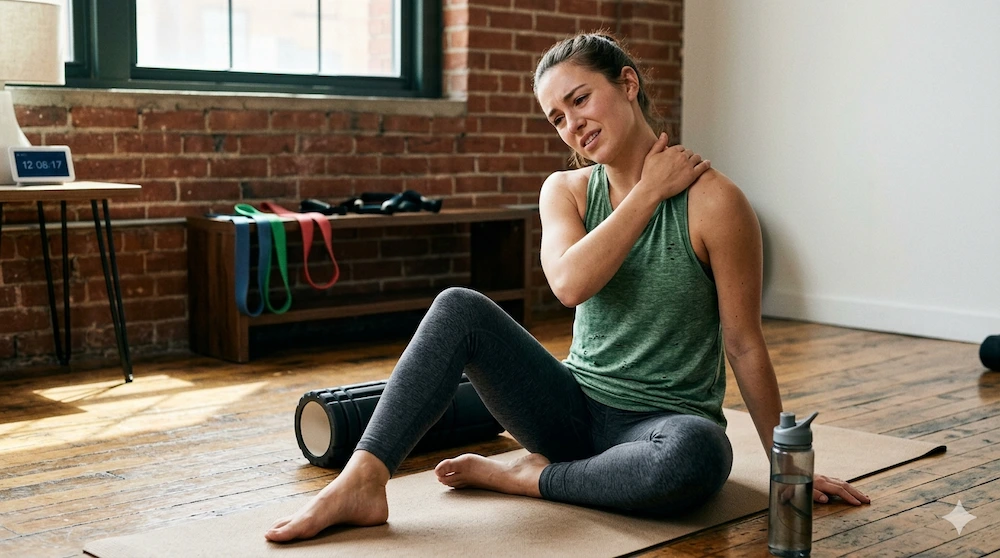
You crushed a workout three days ago — and you’re still wincing every time you stand up or climb stairs. That deep, achy soreness feels like it should have faded by now, right? Delayed onset muscle soreness (DOMS) often peaks exactly at the 48‑ to 72‑hour mark, so feeling sore on day three is not just normal — it’s expected after certain types of training.
The confusion usually comes from not knowing whether that soreness is a sign of effective recovery or a warning of injury. Most people either panic too early or push through pain they shouldn’t ignore — and both mistakes can slow you down.
💡 This guide explains exactly why day‑three soreness happens, how to tell harmless DOMS from an actual injury, and what you can do right now to feel better.
📋 Table of Contents
🔍 What Is Delayed Onset Muscle Soreness (DOMS)?
Delayed onset muscle soreness (DOMS) is the muscle pain and stiffness that appears 12 to 24 hours after unaccustomed or intense exercise — and it typically peaks between 24 and 72 hours. That means feeling sore on day three is not a red flag; it’s actually the classic DOMS timeline.
Unlike acute pain you feel during or right after a workout, DOMS is a natural inflammatory response to microscopic muscle damage. When you perform eccentric contractions — think lowering a dumbbell, running downhill, or the downward phase of a squat — your muscle fibers experience tiny tears. The body repairs those tears and builds back stronger, but the repair process triggers local inflammation, swelling, and sensitivity.
According to the American College of Sports Medicine (ACSM, 2021), DOMS affects anyone who increases workout intensity, duration, or frequency too quickly. It’s equally common in beginners and seasoned athletes after a novel movement pattern.
So if you did lunges, plyometrics, or a new high-rep leg day three days ago, that lingering soreness is your muscles remodeling themselves. The key point is that DOMS should feel like a dull, diffuse ache — not sharp, not localized to one spot.
“Did you add a new exercise type or increase weight/reps last workout?”
If yes, you’re almost certainly feeling DOMS — it’s a healthy adaptation signal, not something to fear.
⏱️ Why Does Soreness Peak at Day 3?
You might expect soreness to be worst the morning after a hard workout. Turns out, the body’s inflammatory cascade takes time to fully unfold. Neutrophils and macrophages — immune cells that clean up damaged tissue — flood the area between 24 and 48 hours post‑exercise. By day three, prostaglandins and bradykinin (chemicals that sensitize pain receptors) reach their highest concentration.
From what I’ve seen, people are often surprised that a Monday leg workout can make Wednesday feel worse than Tuesday. That’s because muscle swelling from fluid shifts continues to build over the first 48 hours, adding mechanical pressure to already tender fibers. Plus, if you’ve been sedentary since the workout, stiff connective tissue amplifies the ache.
A 2019 review in Sports Medicine confirmed that eccentric exercise produces peak soreness at 48–72 hours, with some individuals reporting day three as the most uncomfortable. The exact timing depends on muscle group, training history, and the specific movement. For example, the quadriceps often have a later peak than the biceps because they undergo more eccentric loading in daily activities like walking downstairs.
So no, you’re not imagining it — day three really can be the worst. Worth noting, though: if day four is equally bad or getting worse, that’s when you should start asking questions.
“Is your soreness a dull ache that spreads across the whole muscle?”
If yes, that’s classic DOMS. The peak at day three is your body’s natural repair cycle in action.
⚠️ Normal Soreness vs. Injury: How to Tell the Difference
This is where most people get stuck. DOMS feels like a deep, heavy, diffuse ache that makes muscles tender to touch and stiff when you start moving. An injury (like a strain or tear) usually feels sharp, stabbing, or pinching — often in one specific spot rather than the whole muscle belly.
Here’s a practical breakdown:
Also worth noting: DOMS improves with light activity — walking, easy cycling, or dynamic stretching. An injury typically hurts more when you try to move through it. If you feel a “pop” or sudden pain during the workout, that’s an injury red flag. DOMS only appears hours later.
If you’re still unsure, try this: press into the sore area with two fingers. DOMS hurts broadly; a strain hurts exactly where you press and might refer pain elsewhere.
“Does light walking make your soreness feel better after a few minutes?”
If yes, it’s almost certainly DOMS. Real injuries usually protest more with movement, not less.
🧘 Best Recovery Strategies for 3‑Day Soreness
You don’t have to just suffer through it. Active recovery is the most evidence‑backed approach. A 10–15 minute walk, easy swim, or very light cycling increases blood flow without adding more muscle damage. Blood carries oxygen and nutrients that clear inflammatory debris and deliver amino acids for repair.
Foam rolling and gentle stretching can reduce perceived soreness, but don’t overdo it — aggressive rolling on day three may increase pain. Use a soft roller and stay on each muscle group for no more than 30 seconds.
Hydration is non‑negotiable. Dehydration amplifies muscle stiffness and delays repair. Aim for 2–3 liters of water over the day, especially if you’re still feeling systemically fatigued. Protein intake matters too: consuming 20–30g of protein within an hour after waking helps provide the building blocks for muscle repair. A 2022 meta‑analysis in Nutrients found that adequate protein (1.6–2.2 g/kg body weight) reduces DOMS severity and shortens its duration.
Heat therapy — like a warm bath or heating pad — can relax tight muscles. Cold therapy is more debated; ice baths may blunt the inflammatory response needed for adaptation, so save ice for acute injuries, not routine DOMS.
One thing that rarely helps: total rest. Staying completely still for two days often makes day three stiffness worse because connective tissue shortens. A little movement is your friend.
“Have you moved your body lightly in the past 24 hours?”
Even five minutes of easy walking can accelerate recovery more than another full day on the couch.
🛡️ How to Prevent Extreme Soreness Next Time
While you can’t eliminate DOMS entirely (and you wouldn’t want to — it’s part of getting stronger), you can dial down the severity so day three feels manageable instead of miserable. Gradual progression is the single most effective prevention tool. Increase weight, reps, or volume by no more than 10% per week.
Before your next hard workout, include a specific warm‑up that mimics the movement pattern you’ll be doing — not just five minutes on a treadmill. For example, if you’re doing squats, warm up with bodyweight squats, leg swings, and glute bridges. This pre‑activates the muscles and improves tissue extensibility.
Research from the Journal of Strength and Conditioning Research (2020) showed that a single “priming” session of very light eccentric exercise 48 hours before a heavy workout can reduce DOMS by up to 30%. So if you know a tough leg day is coming, do a few easy sets of the same movements two days prior.
Other practical tips: sleep 7–9 hours the night after training (growth hormone release peaks during deep sleep), and eat a carbohydrate‑rich meal within two hours post‑workout to replenish glycogen and reduce protein breakdown. Tart cherry juice has some evidence for reducing inflammation, but whole foods like berries and leafy greens work just as well.
From experience, the people who suffer the worst DOMS are those who go from zero to hero overnight. A short preparatory week — half the volume — makes a huge difference.
“Did you ease into your last new workout or jump straight to high intensity?”
Next time, try a 50% volume session first — your day‑three self will thank you.
🚨 When Should You See a Doctor?
Day‑three soreness is almost never an emergency, but there are clear red lines. Seek medical attention if you notice any of these: urine that looks dark brown or tea‑colored (possible rhabdomyolysis), extreme swelling that makes the limb feel hard, loss of joint range of motion that doesn’t improve with gentle movement, or pain that wakes you from sleep.
Rhabdomyolysis is rare but serious — it happens when muscle breaks down so rapidly that proteins enter the bloodstream and can damage kidneys. It’s more common after extreme endurance events or thousands of repetitions (like 300 squats in a row). Normal DOMS does not change your urine color.
Also see a doctor if your soreness persists beyond 7 days without improvement. Typical DOMS resolves by day 5–7. If you’re still equally sore on day 8, there might be an underlying issue like a muscle strain or delayed compartment syndrome (very rare).
Finally, if you have a pre‑existing condition — such as fibromyalgia, chronic fatigue syndrome, or a metabolic myopathy — your recovery timeline may differ. In those cases, it’s worth having a conversation with your healthcare provider about what “normal” soreness looks like for you.
In my opinion, the best rule of thumb is: if you’re worried enough to Google it for two days straight, a quick check‑in with a physiotherapist or sports medicine doctor brings peace of mind. Most cases are fine, but that one time it’s not, early intervention matters.
“Is your urine a normal light‑yellow color? Can you move the sore muscle through its full range (even if it hurts)?”
If yes to both, you’re in the safe zone. If not — especially dark urine — don’t wait, see a doctor today.
❓ Frequently Asked Questions
Q1. Is it normal to feel sorer on day 3 than day 2?
A1. Yes, that’s very common. For many people, especially after eccentric‑heavy exercise (like downhill running or lowering weights), the inflammatory response continues to build through 48–72 hours. Day three can be the peak, then it slowly fades.
Q2. Should I work out again if I’m still sore on day 3?
A2. It depends. You can train a different muscle group (e.g., upper body if your legs are sore) without issue. For the same sore muscles, light activity like walking or easy cycling is beneficial, but avoid heavy or explosive training until the soreness subsides to a mild level — usually around day 4 or 5.
Q3. Does stretching help DOMS on day 3?
A3. Gentle static stretching can temporarily improve range of motion and reduce the feeling of tightness. However, aggressive stretching won’t speed healing and might increase discomfort. Focus on dynamic movements first (leg swings, arm circles), then static holds of 15–20 seconds.
Q4. Can lack of sleep make day‑three soreness worse?
A4. Absolutely. Sleep is when most muscle repair happens. A 2019 study in Physiology & Behavior found that sleep deprivation increases circulating inflammatory markers and prolongs DOMS symptoms. Prioritize 7–9 hours after tough workouts.
Q5. Are painkillers like ibuprofen safe for DOMS?
A5. Occasional use is fine, but regular NSAID use can blunt the muscle‑building response to exercise. A single dose on day three if the pain interferes with sleep or daily function is unlikely to cause harm. Always follow the label and your doctor’s advice.
Q6. Why are my legs more sore than my arms after similar effort?
A6. Leg muscles (quadriceps, hamstrings, glutes) are larger and undergo more eccentric loading in everyday activities like walking downstairs. Plus, legs often handle higher absolute loads in the gym. It’s normal for lower‑body DOMS to feel more intense.
Q7. Does massage help on day three, or should I wait?
A7. Light massage can reduce perceived soreness and improve blood flow. Avoid deep tissue massage on day three — the muscles are already inflamed, and heavy pressure may increase microtrauma. A foam roller or gentle self‑massage is safer.
Q8. I’m not sore at all after workouts — is that bad?
A8. Not at all. Lack of soreness doesn’t mean a workout was ineffective. As your body adapts to a routine, DOMS diminishes. It’s called the “repeated bout effect.” As long as you’re progressing in strength or endurance, you’re fine.
Disclaimer: This information is for general educational purposes only and does not replace professional medical advice. Always consult a qualified healthcare provider before starting a new exercise program or if you have concerns about persistent pain or injury. Individual recovery timelines vary.